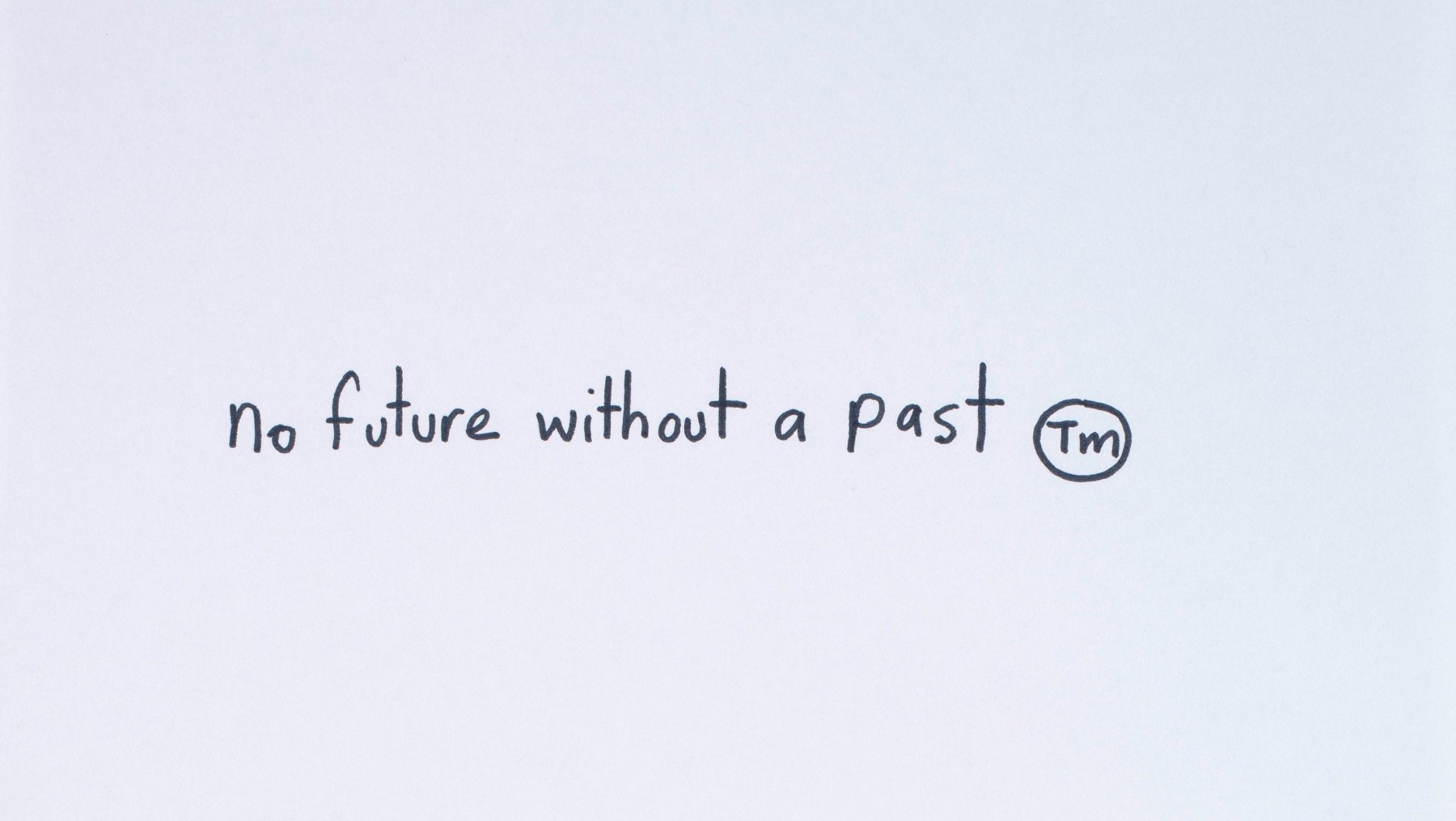
Isabella Hone-Saunders (IHS): This issue’s starting point was the 80th anniversary of art history as a subject at the University of Melbourne, Australia’s oldest art history department.1 As researchers in the field, it quickly became apparent that we (the editors) didn’t want to merely celebrate the department but instead to critically question the past and future of the discipline in Australia. This led us to artist Gordon Bennett’s provocation no future without a pastTM, a line that challenges the neatness of linear time.2 By citing Bennett’s words as the issue’s title, we wanted him to set the tone and be present as a central figure in our thinking. In a similar way, we were drawn to the temporal disruptions and collisions in Ryan Presley’s work, particularly his painting Our life of tranquillity undisturbed (2026) that fittingly collapses the art historical into an asynchronous present. Presley’s work opens the issue and, along with his accompanying article, invites readers to consider the contingencies of our contemporary moment through the bittersweet metaphor of finding wildflowers amid the rubble of a 500-year history of colonial modernity.
As the eye travels through Presley’s painting, it reveals itself as a pastiche altarpiece that combines Baroque, Renaissance and Neoclassical references and portrays a young Aboriginal Adonis. Our lifestyle of tranquillity undisturbed (2026), which won the Telstra Art Award at the Telstra National Aboriginal and Torres Strait Islander Art Awards (NATSIAA) at the Museum and Art Gallery of the Northern Territory in August 2026, shows that art history is something made in the present from the rubble of the past, and as Bennett suggests, is something necessary to build a future.
In the context of our attempt to look at what art history enables and constrains, Suzannah, how do you think Ryan’s work and Bennett’s quote collapse the distance between European art historical traditions and the lived reality of sovereign resistance? If the past is constantly rupturing the present and the future, how do these voices reframe Art + Australia and this issue as an active site of confrontation?
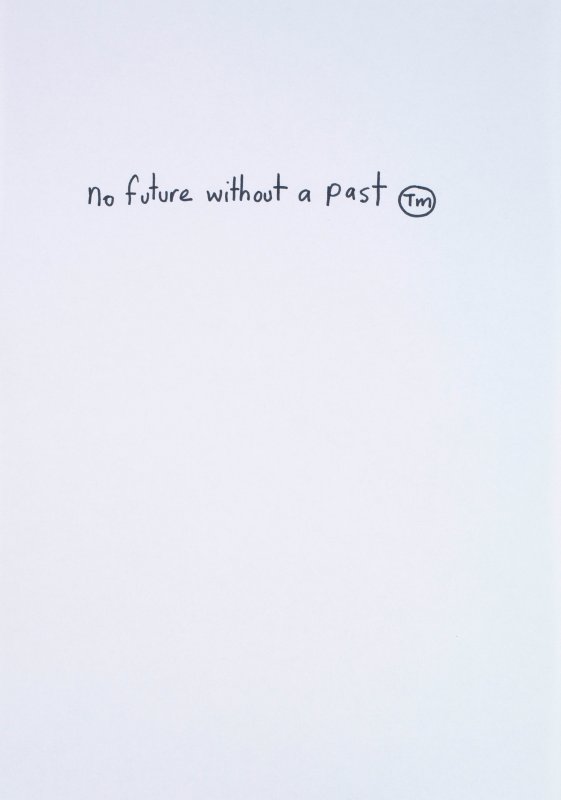
Suzannah Henty (SH): no future without a pastTM is an aphorism used by Gordon Bennett, appropriating the title of hip hop group Leaders of the New School’s debut album, A Future Without A Past… (1991). I understand Bennett’s phrase as a satirical take on history as a construct, with the trademarking of ‘past’ symbolising its status as a commodity. I first saw the slogan on the back of the catalogue for Bennett’s 2016 exhibition Be Polite at the Institute of Modern Art, then found Untitled (No Future Without A Past), written in texta on an A4 piece of paper in 1998, on Bennett’s representing gallery’s website. Later, contributor Ian McLean emailed me a photograph of Notes to Basquiat: Cut the Circle II (2001), which includes the phrase on the bottom-left corner of the canvas. Knowing that Bennett returned to this phrase as a strategy for sitting with the legacy of Western art history (Notes to Basquiat includes Jackson Pollock’s painting Blue Poles) became a way for us to approach this issue as a reckoning with the colonial legacy of the discipline. Bennett’s phrase points to a central tension addressed in the issue: that challenging the idea of ‘art history’ requires engaging with the structures that define it, even as we seek to imagine it differently.
I was recently listening to a lecture by my colleague Mark Erdmann where he described the essence of art historical research as attending to the minutiae of material, economic, environmental, iconographic and discursive detail of artists and artworks to understand how the past informs the present. He made the point that if you see your kid drawing in an anime style at the kitchen table, it is neither accidental, nor is it predetermined, but the outcome of intersecting historical forces that connect Japanese artistic traditions to the world through culture and geopolitics. Hearing him succinctly explain how art historical research offers a window into our social and political history reminded me that its inherent interdisciplinarity is one of the things I love most about it. I was similarly struck during one of Ian McLean’s lectures on Australian art when he would highlight that if an artwork is a window into the soul of an artist, then Australian art is the window into the soul of the nation. This window that Ian describes encompasses art that draws on a 65,000-year history of continuing First Nations culture and the subsequent rupture of a 250-year history of colonial occupation. As Nur Shkembi writes in this issue, and from my experience of teaching and researching Australian art, this history is a ‘field of colossal erasures’. Equally, as Miguel Gaete argues in this issue, this window as a frame or a lens is always partial and situated, which challenges the European art historical tradition that universalised ideology under the guide of academic objectivity. As editors of this issue, we have been more interested in the rhizomatic nature of art history that allows us to connect people, places and things to challenge a hegemonic whole – or ‘canon’ – and reposition it as a narrative in flux that Ryan’s painting directly captures. He astutely draws his own connections between figures, places, times and artistic styles to create a tableau that invites the viewer into the political consciousness of Australia and critically situates us here, in the present. It is its own window onto the soul of the nation, that is a form of sovereign resistance.
IHS: For this edition, we have had the pleasure of assembling a dissonant, fiercely smart and critical constellation of voices that refuse to flatten Australian art history into a single, cohesive narrative. We have brought together contributions from Ian McLean, Nur Shkembi, Paul Boyé and Robert Cook, Tony Albert and Lisa Slade, Sary Zananiri, Rosalina Coulter, Michael Gentle, Miguel Gaete and Ryan Presley, with some additional voices to come. Rather than presenting a unified front, the issue reads more like documentation of a history of ongoing conflicts, institutional reckonings and alternative genealogies. Together, these contributors actively shift the stakes of what art history is, and what it can do in this country. As we look through this issue, Suzannah, how do you see these texts acting as critical disruptions to the traditional, institutional canon of Australian art history? What kind of future are we charting for the discipline when we allow these distinct, geographically and politically diverse histories to collide?
SH: Throughout the issue we see art history as an active discipline that constantly needs to be revised and rewritten to confront those erasures that Nur speaks of. There are arguments that connect and diverge to assert and contest the canonical history of Australian art and the nation. In terms of the nation, we can see a disruption of identity and national borders, where Sary and Nur highlight trade routes connecting Australia to Makassar and Palestine. This nation, as Sary and Ian note, is also defined by the crucible of war. Both historians turn to the impact of the First World War in their articles, but where Sary traces trans-national exchanges that connect Bethlehem to Kamberri/Canberra via Jawi Country, Ian argues that the war was critical to consolidating a conservative Australian national identity.
While Sary and Ian reckon with the contested provenance of objects and historical ephemera, artists are central to the issue as historical figures, voices and as nodes for navigating and revising history. There is Bennett and Presley, the Chilean Australian artist Juan Davila and Margaret Preston who each appear across several articles. The latter reprises in an interview between Lisa Slade and Tony Albert as a figure with whom Tony critically engages. In their discussion, we can see how Tony contests some of Preston’s culturally appropriative work, whilst also connecting with other artistic figures such as Albert Namatjira by visiting and rebuilding Namatjira’s house located by the Lhāra Pinta/Finke River. This dialogue with artists from the past continues, as Michael Gentle’s poem also leans on Gordon Bennett’s words. Michael pieces together personal notes, poems and inscriptions from Bennett’s letters, artist statements and the versos of his canvases into a reflection of Australian history that presses on the colonial wound by asking us to come to terms with the past’s claim on the present.
Isabella, the idea of a national image that haunts Australian history is unsettled by highly focused and localised analyses of art and culture that attend to specific people and places across time. How do you see these contributions oscillating between the national and the local, and what tensions emerge in that movement?
IHS: Ian McLean and Rosalina Coulter bring these grand institutional questions directly down to the physical geography and administrative structures of the University of Melbourne itself, specifically through the historical arcs of Art + Australia and the Student Union’s George Paton Gallery (GPG). Ian introduces Pat Hoffie’s concept of ‘enforced amnesia’ to describe the function of art publications in maintaining hold of the present: they act as vehicles for the contemporary, culling the past and tracking the ‘moving edge of the ever new’.
Nur brings a necessary, sharp-edged rage to the systemic erasure of Islamic aesthetics and cultural exchanges that pre-date white settlement, such as the centuries of Makassar contact with First Peoples, which the discipline has dismissed as archaeology or social history rather than art history. Citing Geeta Kapur’s provocation that the history of art must be written alongside the history of humanity, Nur demands: where are all the ragers in the academy? She calls for us to write ‘backwards and forward at once,’ moving past safe, comfortable theorising to engage in the real-time, hands-on, collaborative work of community-led reclamation. This urgent demand to confront the unresolved, violent inheritances of the past collides beautifully with Paul and Robert’s analysis of the West Coast (specifically Boorloo/Perth) as a site of ‘permanent renovation’. In holding these two positions together, we are forced to ask: How do we foster a generative, decolonial rage within academic spaces that are themselves structured by this very logic of institutional extraction? Our task as editors has been to navigate the ‘enforced amnesia’ of the present. I feel we must look at how our contributors dismantle the neat, self-legitimising objectivities of the Western academy by inverting the geographic and epistemic margins of the continent. I am thinking here of the friction between the contributions of Nur Shkembi and the co-authored text by Paul Boyé and Robert Cook. How do we write the history of ‘what actually happens here’ when the ‘here’ is a constantly hollowed-out terrain designed to keep us going ‘through the motions’?
SH: The contributors hold open the discipline’s contradictions and resist the impulse to reconcile its tensions or offer neat resolutions. Invasion, genocide and the legal, social, political and cultural systems of administration that are the legacy of settler colonies have structured the Australian art history canon, which encompasses an obfuscation of the nation’s foundational violence and the extractive practices that produce it. Today, writing Australian art history necessarily requires encountering this legacy of settler-nationalism and the institutional structures through which Australian art history has been canonised. We can do this by acknowledging our implication in these structures and by, as Rosalina insists, turning to the radical potential of the contemporary moment by learning from past battles rather than being burdened by them. As our issue no future without a pastTM shows one way of learning from past battles is to create space for its conflicts and issues. As Bennett suggests, if we ignore or deny the uncomfortable and violent truths of the past, then Australia '...will only ever be half a nation’.3
We would like to thank and acknowledge Kyle Harvey for editing this issue, Jeremy Eaton and Art + Australia for guiding us and the contributors throughout this process, and the Art History and Art Curatorship Program at the University of Melbourne for its support. Finally, we extend this gratitude and thanks the contributors for their generosity and intellectual commitment to the issues and questions that animate this issue.
1. We acknowledge, of course, that any claim for the ‘first’ in Australian history is notoriously unstable.
2. Gordon Bennett, Untitled (No Future Without A Past), 1998, texta on paper, 29.5 cm x 21.0 cm.
3. Anne Kirker, ‘Gordon Bennett: Expressions of Constructed Identity’, [interview, 1990], in Angela Goddard and Tim Riley Walsh (eds), Gordon Bennett: Selected Writings, Power Publications and Griffith University Art Museum, Brisbane, 2020, p. 126.
Author/s: Suzannah Henty & Isabella Hone-Saunders
Suzannah Henty & Isabella Hone-Saunders. 2026. “Editorial.” Art and Australia 61, no.2 https://artandaustralia.com/61_2/p440/editorial
Art + Australia Art + Australia ISSN 1837-2422 All content published after October 2023 by Art + Australia is available under a Attribution-NonCommercial-NoDerivs 4.0 International Licence (CC BY-NC-ND 4.0) except where otherwise stated. For more information about use and distribution you can view our Editorial Guidelines. Art + Australia is a University of Melbourne research project
Publisher: Victorian College of the Arts
University of Melbourne


