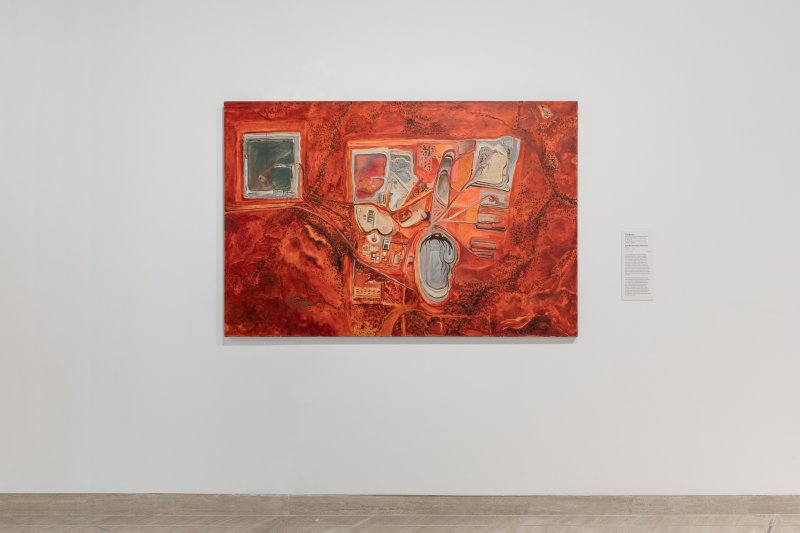
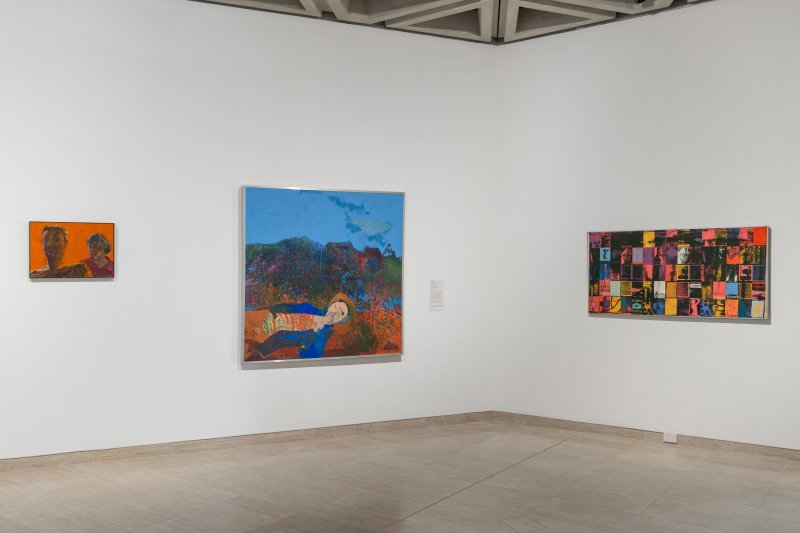
The first three artworks at the entrance of Tim Burns – The Kinetic Moment introduce a cunning conceit in Burns’ first solo exhibition at a state institution. Straight ahead are enlarged wall-sized stills from a Super 8 recording of Burns’ 1973 performance Whistle & Clap, in which silkscreened fruit boxes (à la Warhol’s Brillos) were rigged with explosives and detonated amongst gallerygoers at Sydney’s Liverpool Art Prize before the swift intervention of the venue manager. To the left is a portrait of Tim and his mother Elsie ‘Joy’ Burns in fiery oranges by George Haynes, who taught Tim to paint in the late 1960s. To the right hangs Burns’ large painting Self-portrait as a mine site (2025), a curvy, amorphous, and pareidolic depiction of an open-pit mine. This introduction, devised by curator Aimee Dodds, sets the scene for The Kinetic Moment to be as much a portrait of the artist as a survey of his work—one that includes several of Burns’ collaborators and mentors.
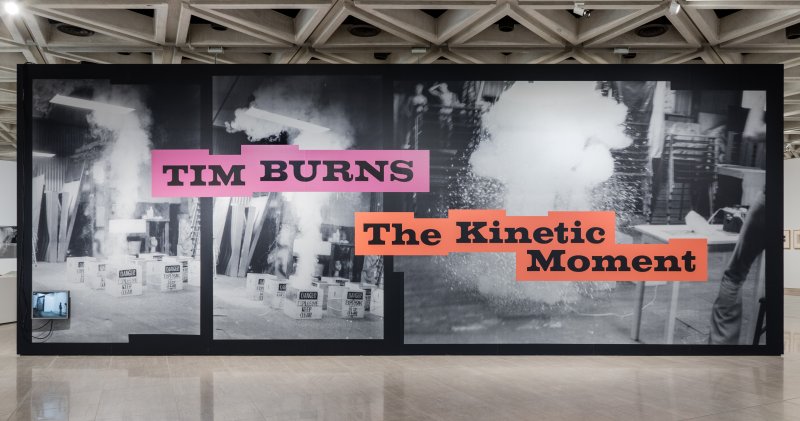
The Kinetic Moment celebrates the conceptual rigour, fierce nonconformity, and larrikin-ish iconoclasm of an artist who has long remained on the peripheries of the history of Australian avant-gardism. Artists whose work varies in mode, medium, context, and documentation to the extent that Burns’ does are often the bête noire of the art historian—difficult to situate within a neat historical or disciplinary context. Frequently mystified by conflicting anecdotes and convoluted notoriety, the challenge for presenting work of this nature is to parse the substantive from the circumstantial.
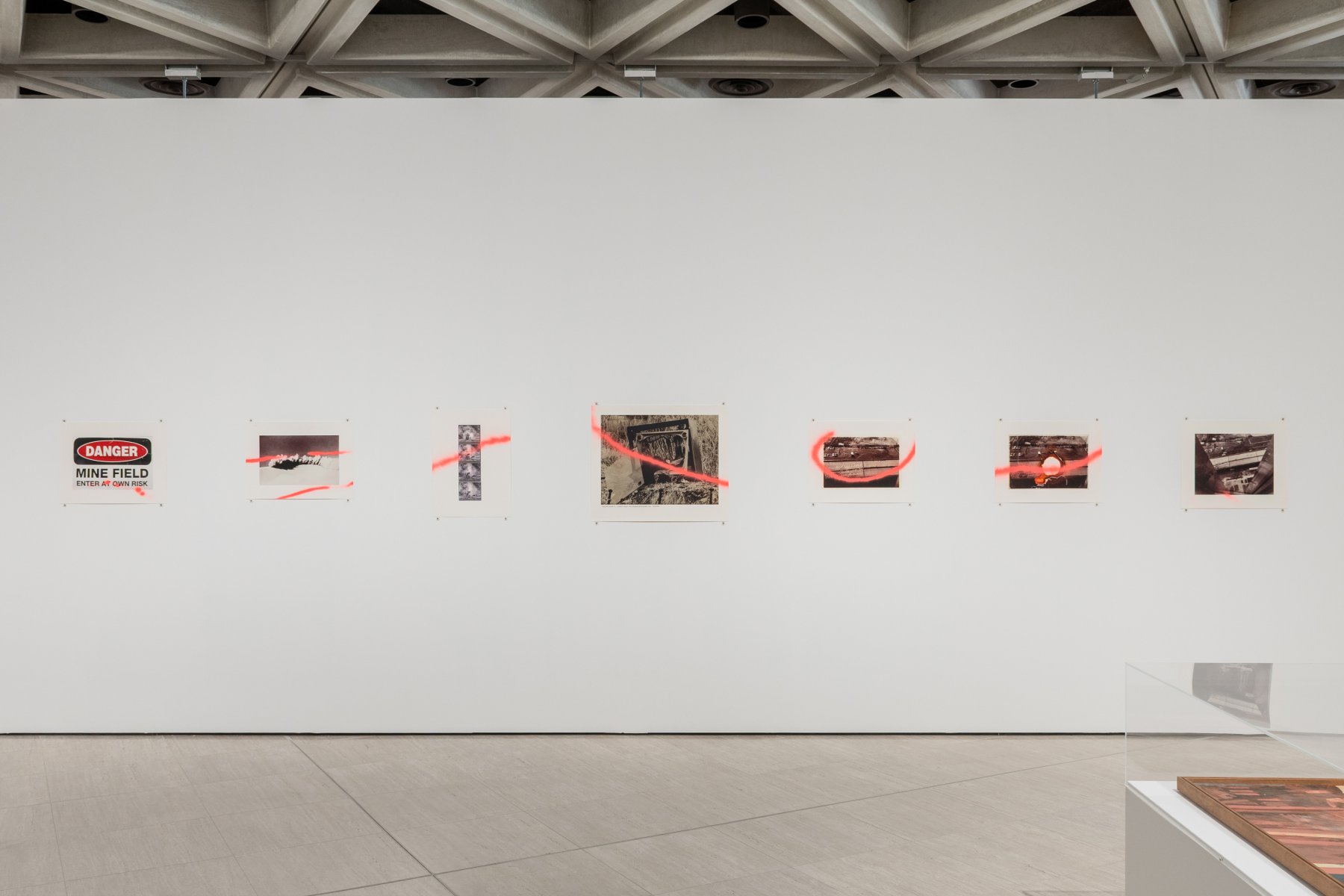
Burns’ work, particularly his performances, often blurs the line between the anecdotal and the actual artwork. This is exemplified by several works in the show, including Fuck (1972), for which Burns was arrested for ‘indecent language’ after brandishing the offending poster that read ‘Fuck Laverty and the trustees – this is a work of art!’ (in reference to Peter Laverty, then Director of the Art Gallery of New South Wales, AGNSW). Another example is his infamous land artwork Minefield (1973), in which Burns attempted to rig a 400-square-metre field with small explosives to titular effect—intending to leave attendees to ‘enter at their own risk’ during the 1973 Mildura Sculpture Triennial. Minefield survives through a series of photographs and a Super 8 recording of its demolition, which was ordered by the local council after Burns accidentally burned himself detonating a charge. And there is Burns’ A Change of Plan (1973), in which visitors to the AGNSW could observe two nude performers (Barry Prothero and Ursila Maerle) via a closed-circuit television. A naked saunter across the foyer of the Gallery to the toilets by Prothero resulted in his arrest, during which twenty or so members of the public also downed trousers in protest.1
Such tales have become the prevailing lens through which Burns’ work is received, and an exhibition built on them could easily leave the viewer playing “detective”, sifting through accounts, documentation and interrelated anecdotes to make sense of the art. Burns and Dodds avoid this trap by selecting the paintings, prints, films, photographs and ephemera that visually enrich one another and offer alternatives to the prior interpretations—allowing for what might otherwise be textual theses to be introduced visually. The treatment of Burns’ association with explosives is a case in point, one in which curatorial decisions manoeuvre the viewer beyond spectacular anecdotes and rote interpretations. Prints and footage of violent detonations are peppered throughout the gallery, such as Minefield, Exploding Sand Dune (1974), Exploding TV, Boya Quarry (1974) or the aforementioned Whistle & Clap. In a 1974 interview on the ABC television program GTK (or “Get to Know”) included in the exhibition, Burns is identified on screen as “Tim ‘Dynamite’ Burns”—an early example of the kind of “outlaw explosion artist” association that frequently follows Burns.
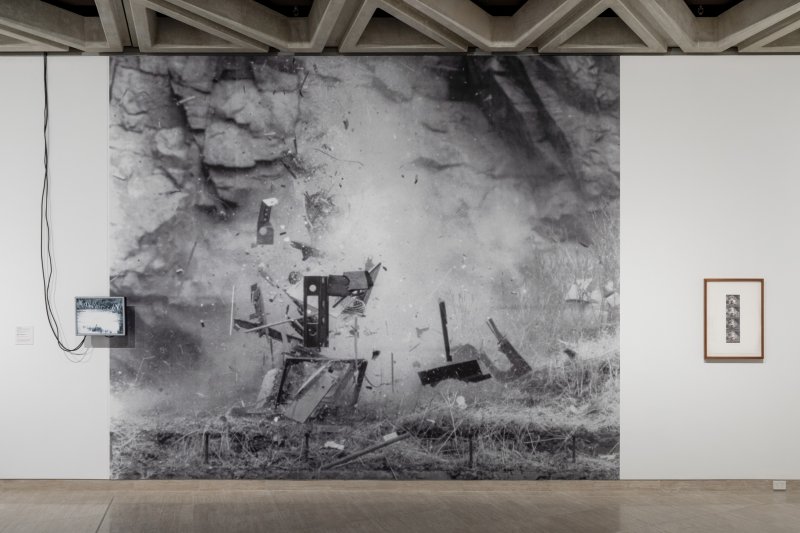
The motifs of exploding televisions, booby traps and sand dunes, combined with Burns cinematic documentation of it, exude a kind of countercultural, post-Zabriskie Point violence: the explosion of hippydom, from whose debris emerges a dystopian chaos. Yet, The Kinetic Moment convincingly reminds us that, in Burns’ own words, he is a ‘context artist’.2 The inclusion of one of Burns’ early oil paintings in The Kinetic Moment supports an alternative narrative to all this machismo: one that establishes Burns’ fascination with and use of explosives in a familial context. Death of a Miner, exhibited at Burns’ first solo show in 1969, is a vivid depiction of the titular aftermath of what one presumes, by the violent splatters and gash marks along the figure of the miner, is some horrible accident. Following the unexpected death of his father in 1962, Burns began searching for family photographs at the State Library of WA, discovering family histories in the records of various Mid West mines, along with ‘highly staged photos of mine bosses and their workers’ that intrigued Burns for their depiction of class and power. Later, while still in art school, Burns worked as a shotfirer—positioning and detonating explosives at Western mining sites.3 In this sense, Death of a Miner (along with its recent counterpart Self-portrait as a mine site) visually shifts the tone of Burns’ fascination with explosives: away from a purely countercultural drive for radical expression, and toward a more familial and familiar rationale that is grounded in an intimate appreciation of working class labour.
Five of Burns’ films are screened in darkened theatrettes in the gallery: Why Cars? CARnage! (1977), Political Transmission (1978), Against the Grain: More Meat than Wheat (1980), Thus Went Phillipa (1981), and Luke’s Party (1991). On my visit, a scene from Why Cars? was rolling, in which Burns is seen meandering the streets of Detroit, mic in hand, interviewing anyone willing to stop and chat. Burns is on a mission: to convince his interviewees to join him in abolishing private cars. ‘So why do you want cars to be discarded,’ asks one Motor City local. ‘They’re a real heavy use of resources', responds Burns, 'they’re fucking the country up, they’re making highways everywhere and they’re cutting neighbourhoods up. They’re ruining the whole trip! ... Public transport moves a lotta people more easily for less energy!’ It is difficult not to think of Burns as some kind of proto-Louis Theroux, or as a leftist version of the Louder with Crowder “Change My Mind” meme. It is a quality that is one of the great joys of Burns’ films, as they so often hit curious notes of out-of-time-ness—that mysterious doubling of being “ahead of its time” while also so obviously of its time.
In ‘Theses on the Philosophy of History’, Walter Benjamin develops a critique of the familiar concept of historical progression (i.e. X leads to Y, which leads to Z), which he views as a kind of ‘homogeneous, empty time’.4 For Benjamin, the historical materialist must ‘blast open’ this empty time to be able to free the particular moment or era from the burden of the ‘continuum of history’ and view it on its own terms in direct relation to the present.5 Knowingly or not, this appears to be the very model utilised for The Kinetic Moment: In this sense, the exhibition avoids a revisionist approach, one that would simple situate Burns with a continuum. Instead, it “blasts open” particular objects, photographs, and documentation from what could be a densely, if not tediously textual exhibition, to present them in innovative ways that reignite the material with newfound excitement. Nowhere in The Kinetic Moment is this more evident than in the unique presentation of Burns’ Start–Finish Event?, a bizarre intervention that took place at the Contemporary Art Society’s Projects Show. On the brisk Sydney evening of 28 June 1973, while a large crowd gathered on a rooftop terrace for sociologist Vivien Johnson’s forum Art and Social Politics, Burns set to work on the floor below, having advertised that a performance would occur sometime after the forum. Waiting for some happening to begin, guests turned from patient to bored. As the crowd began to leave in frustration, they found 25-kilogram blocks of ice blocking the exits. Whether they broke through or waited for the ice to melt, their escape was again thwarted—the staircase having been covered with polyurethane foam that oozed down the plastic-covered stairs like a scene from a horror film.
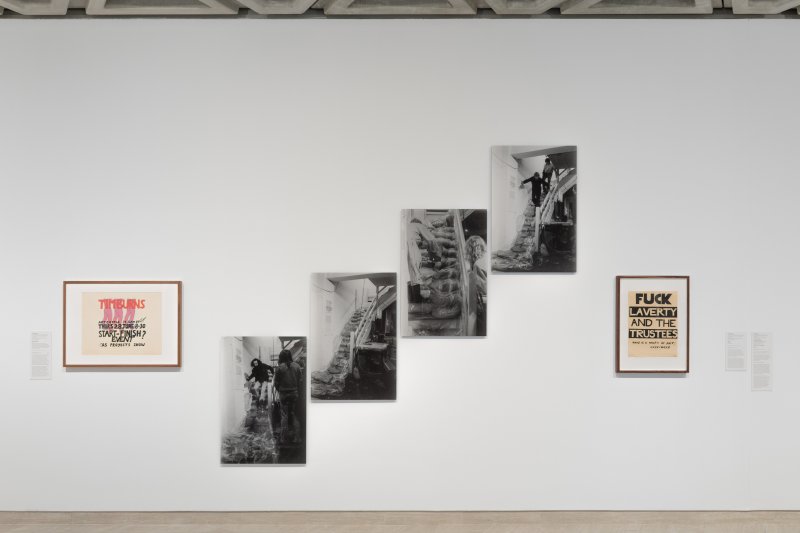
Along with the original screen-printed advertisement for the “performance” that was the bait for Burns’ trap, four enlarged photographs of the event, found in the National Art Archives at the Art Gallery of New South Wales, have been selected. Rather than presenting the original documentary photographs of Start–Finish Event? in a vitrine—leaving viewers to peer at the neutered remnants of the once-radical event—the images of Burns’ orchestrated chaos are enlarged, printed on aluminium and comically displayed in a diagonal cascade to emphasise its subject’s unsettled decent down the staircase. As critic Cassandra Otterman-Emmett notes in a recent review, there is a comedy that runs through much of The Kinetic Moment.6 It is this humour that encourages a lively, playful, enthusiastic encounter throughout the exhibition. Perhaps here, in the humorous Benjaminian blasting of Burns’ oeuvre is the curatorial approach of the much-needed state institution surveys for fellow Yellow House alumni George Gittoes, Gretel Pinniger (aka Madam Lash), and Martin Sharp. If so, The Kinetic Moment offers a compelling model—one that visually revels in the rebellious spirit and seductive out-of-time-ness of Burns' lifework.
1. Aimee Dodds, “Pseudo Alarm: Rereading Tim Burns,” un Magazine 18.1, Badaud, ed. Tara Heffernan (un Projects, 2024), https://unprojects.org.au/article/pseudo-alarm-rereading-tim-burns/. All three aforementioned artworks are examined in a new essay by former Art & Australia editor, Edward Colless, included in the expanded exhibition catalogue by Aimee Dodds.
2. Aimee Dodds, introductory wall text, Tim Burns – The Kinetic Moment, Art Gallery of Western Australia, Perth, October 17, 2026–February 28, 2027.
3. Aimee Dodds, wall label for Tim Burns, Death of a Miner, 1969, oil on canvas, University of Western Australia Art Collection, in Tim Burns – The Kinetic Moment, Art Gallery of Western Australia, Perth, October 17, 2026–February 28, 2027.
4. Walter Benjamin, “Theses on the Philosophy of History,” in Illuminations, ed. Hannah Arendt, trans. Harry Zohn, 4th ed. (Fontana/Collins, 1982), 263.
5. Benjamin, “Theses on the Philosophy of History,” 264.
6. Cassandra Otterman-Emmett, “Tim Burns – The Kinetic Moment,” Dispatch Review, November, 2026], https://dispatchreview.info/Tim-Burns-The-Kinetic-Moment-by-Cassandra-Otterman-Emmett.
Author/s: Sam Beard
Sam Beard. 2026. “The Continuum Explodes: Tim Burns, Out Of Time And In The Gallery.” Art and Australia 61, no.2 https://artandaustralia.com/61_2/p619/the-continuum-explodes-tim-burns-out-of-time-and-in-the-gallery
Art + Australia Art + Australia ISSN 1837-2422 All content published after October 2023 by Art + Australia is available under a Attribution-NonCommercial-NoDerivs 4.0 International Licence (CC BY-NC-ND 4.0) except where otherwise stated. For more information about use and distribution you can view our Editorial Guidelines. Art + Australia is a University of Melbourne research project
Publisher: Victorian College of the Arts
University of Melbourne


