The proposition of there being no future without a past, carries a particular resonance within Australian art historiography. To begin with, any discussion of cultural heritage here must be grounded in the reality of more than 60,000 years of First Nations presence and knowledge systems. By its very nature, such temporal depth rightly challenges our inherited art historical frameworks that privilege colonial timelines and European points of origin.
The recovery of women artists, First Nations cultural production and other marginalised histories demonstrate that art history is never a neutral record of the past. Rather, it is a field shaped by acts of selection, omission and interpretation; in other words, it is a field riddled with colossal erasures. If we are to consider this incomplete history with due criticality (and a touch of rage), there is without doubt elements of our humanity missing. Art historian Geeta Kapur has rightly stated that the history of art should be written alongside the history of humanity. According to Kapur, ‘it is a commitment to see the history of art in conjunction with the history of humanity—a proposition that is humble, self-evident and audacious’. 1 To truly understand Kapur’s proposition, we must reflect on both its epistemic complexity and deeply human framing. Beyond offering a powerful and essential methodology for art historians, it compels us to confront the geopolitical realities of the present alongside the unresolved inheritances of our often violent colonial pasts.
With regards to recent rewriting of histories of the pre-colonial and colonial period of White Australia, art historians are comparative latecomers to this work. For example, if we take the presence of Muslims in Australia, which pre-dates White settlement, and extend our view to Islamic aesthetics and cultural exchange, there is scant research covering this area despite its significance in Australia’s pre-colonial history. The material and visual culture associated with Makassar traders, followed by the arrival of the Afghan cameleers and Malay pearl divers, has largely been treated as a marginal social history or archaeological examination, and rarely explored in art history.
The history of Makassar fishermen engaging with First Peoples from the fifteenth century raises important questions.2 What forms of artistic production and expression emerged through these encounters? What visual cultures were sustained, transformed, or forgotten? And, most significantly, why have such critical histories remained peripheral to dominant accounts of Australian art?
For centuries, Islamic objects were highly visible within European collections and were celebrated for their aesthetic qualities, craftsmanship and perceived exoticism. In Australia, however, despite the earnest adoption of British museological practices by collecting institutions, the acquisition of Islamic objects rarely translated into substantial institutional holdings.3 For the most part, Australian interest in Islamic art has been either mute or arbitrary. In recent years, any activity in this field has heavily relied on the interest and good will of individual collectors, and the dedicated—often self-directed—work of a small number of curators and scholars within our institutions.
Some examples of this recent activity can be seen in the 2005 exhibition Crescent Moon: Islamic Art and Civilisation in Southeast Asia, jointly presented by the Art Gallery of South Australia (AGSA) and the National Gallery of Australia (NGA) and coinciding with AGSA’s first permanent display of Islamic art. This was followed by the Art Gallery of New South Wales's landmark exhibition The Arts of Islam: Treasures from the Nasser D. Khalili Collection (2007), and later AGSA exhibitions Love from Damascus: The Art of Devotion in Islam (2019) and No God but God: The Art of Islam (2020). While these exhibitions represented important institutional moments of recognition, prior systemic failures to engage the field exposed the absence of sustained collecting, curatorial investment and ongoing representation of Islamic art within Australian museums.4
This institutional absence became the catalyst for my own curatorial practice. Rather than waiting for museums to collect or exhibit contemporary Muslim artists, I sought to create the cultural infrastructure that did not yet exist. What I discovered in my work, which was immersed in community, was that many artists were not only engaging with recognisable Islamic visual traditions but were also articulating Muslim identities through conceptual practices grounded in lived experience, migration, memory, politics and belonging. Their work revealed an emerging Islamic visual vernacular shaped as much by absence as by inheritance.
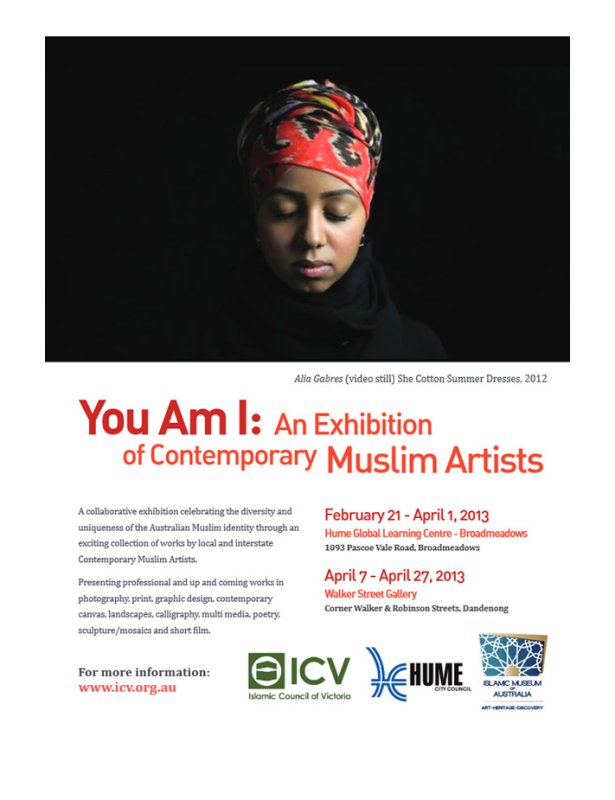
In response, I launched a nationwide call-out for Muslim artists, resulting in You Am I: An Exhibition of Contemporary Muslim Artists. First presented in 2009 at the Hume Global Learning Centre in Broadmeadows, Victoria, You Am I evolved into a nationally significant annual exhibition over five years. More than a survey exhibition, You Am I functioned as a curatorial intervention, creating one of Australia's first sustained platforms for contemporary Muslim artists, fostering new artistic networks and establishing a critical space for the visibility, discourse and development of contemporary Islamic art. However, in this burgeoning practice of exhibition making with a focus on Islamic art another absence was made apparent.5 The critical reception and documentation of these emerging practices was sorely lacking. At the time, there was little to no interest in contemporary Islamic art.
While Islamic art history can be viewed as a fundamentally Western-based Orientalist field, recent scholarship has sought to interrogate its foundations through postcolonial and decolonial methodologies. Despite these efforts, the discipline remains marked by deep epistemic fractures.6 The omissions within the discipline are neither incidental nor confined to periods, styles or media; they do, in fact, amount to a deliberate erasure of peoples and of lived experiences. In other words, the artists, communities and intellectual traditions from which these works emerged have, for the most part, been systemically obscured.7 What emerges is not simply an incomplete history, but a grand narrative structured by Orientalism, imperial desire and the brutal logic of empire. This is a historiography that in many ways functions as a testament to the self-legitimising impulses of Western modernity that course through our institutions.8
Islamic art here offers a compelling example of the limitations of art history when practiced through so-called Eurocentric ‘objectivities’. To rewrite art history—or at the very least create a meaningful rupture—requires a type of passion or rage, and an uninterrupted critical practice within the academy that has origins outside of it. This moment in art historical scholarship reveals the urgency of privileging and supporting marginal histories, informed by exhibition making practice and collaborations. In other words, this is the real-time-hands-on work of the making of art/history that many in my field are currently doing. We can continue to unpack the formal terminology and theory around art history as praxis, and collaborative models incorporating grassroots work of communities committed to reclamation. Yet I suspect (and hope) we are now sufficiently prepared to move beyond simply theorising or continuing with the usual business of writing about writing art history. Because when we fail to amend the erased histories of the marginalised, we ultimately remain complicit in dehumanising not only individual artists, but also entire communities. By providing a sustained platform within the academy that truly grapples with the multiplicity and difficulty of this work, we can engage effectively in the careful restoration, documentation, deep listening and collaboration with the communities and traditions from where the art and artists originate.
Beyond the necessary revision of past art histories, we must also acknowledge the simultaneous histories that continue to unfold in real time. Art historians must essentially engage in the unforgiving work of writing backwards and forwards at once. Because ultimately, the task of contemporary art history is not simply to expand the canon with more timelines and facts, but to question the conditions under which it was formed. As we have observed, some of this work is already underway, but again, it requires more than the grit and will of individuals and communities alone. And for me personally, I have another essential question to ask: where are all the ragers in the academy?
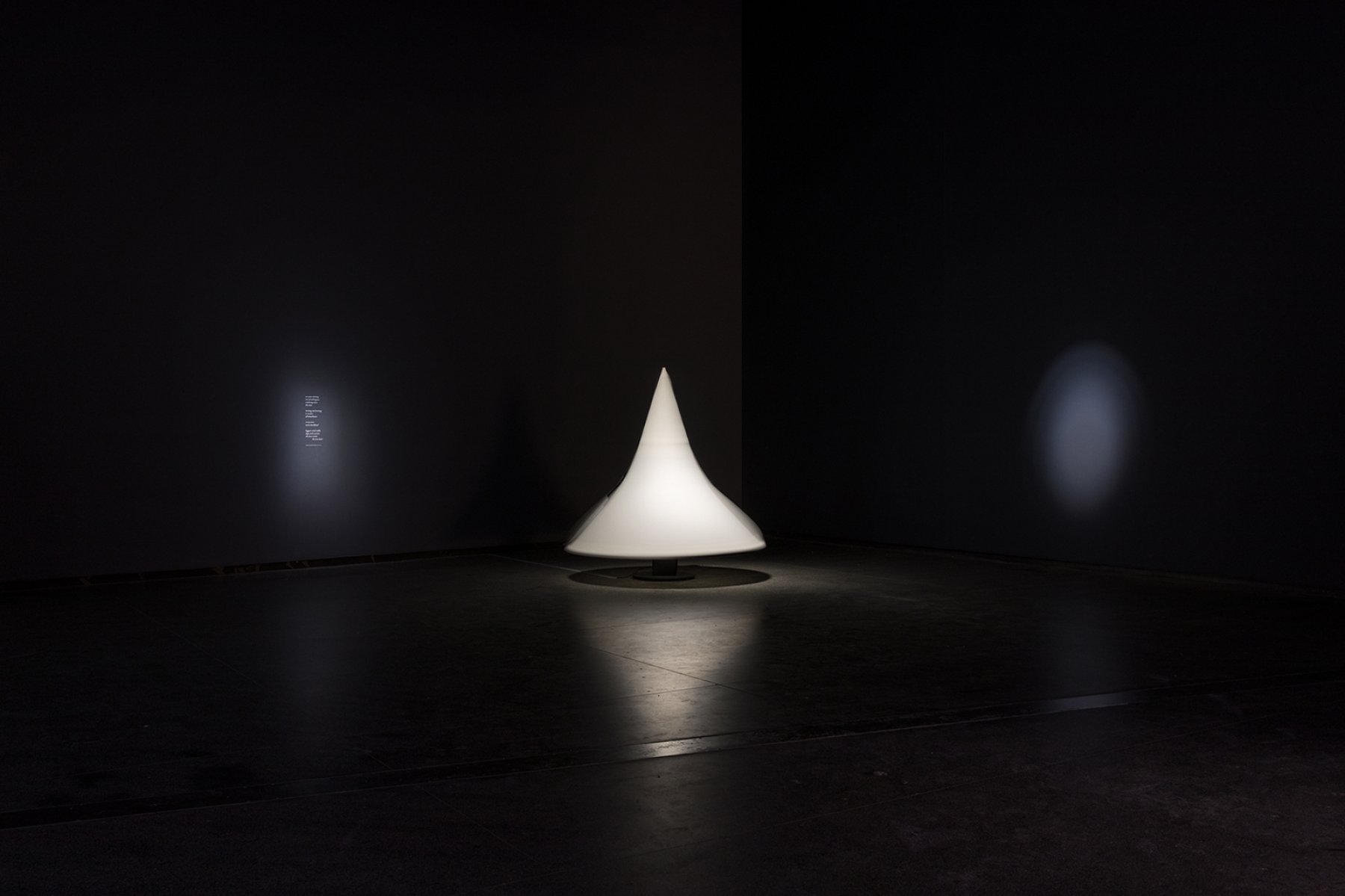
Hero Image: Hossein Valamanesh, The lover circles his own heart, 1993 (Paris edition 2017), silk, modal and electric motor, controller, support structure and wire, 190 x 190 cm. Collection of the artist estate. Courtesy the artist and Angela Valamanesh. Installation view Five Acts of Love, Australian Centre for Contemporary Art, Melbourne, 2025. Curated by Nur Shkembi. Photograph: Andrew Curtis.
1. Transcript of keynote lecture ‘Recursive Narrative: Ways of Producing Art History’, Haus der Kunst, Munich, 14 October 2016. https://postwar.hausderkunst.de/en/blog/recursive-narrative-ways-of-producing-art-history-by-geeta-kapur.
2. Dzavid Haveric, History of Islam and Muslims in Australia: Early Encounters, Settlements and Communities prior to the mid-1940s, Lambert Academic Publishing, Saarbrücken, Germany, 2019, p. 9.
3. Nur Shkembi, ‘Destiny Disrupted: Contemporary Islamic Art and the Neo-Orientalist Turn’, PhD thesis, University of Melbourne, 2023, p. 81.
4. What we essentially end up with is a series of temporary or visiting exhibitions, which acts as a ‘bandaid’ solution to a deeper issue of the ongoing lack of engagement with Islamic art in Australian institutions. This impacts both the institutions themselves as serious collectors of ‘global art’ and the local communities who identify with an Islamic heritage. See Shkembi, ‘Destiny Disrupted’, PhD thesis, pp. 94-107.
5. Nur Shkembi, ‘Destiny Disrupted: A History of Contemporary Islamic Art in “Australia”’, in Tristen Harwood, Grace McQuilten and Anthony White (eds), Variations: A More Diverse Picture of Contemporary Art, Monash University Publishing, Melbourne, 2023, p. 75.
6. Historian of Islamic art, Avinoam Shalem, has provided a critical analysis of the scholarship and points to numerous outdated methods and attitudes which includes gross stereotypes generated by Orientalism, coupled with the tendency to allow historical writings to remain unchallenged. Shalem writes: ‘Several articles by Oleg Grabar, Sheila Blair and Jonathan Bloom address the complexity of Islamic art history, and recently Finbarr Barry Flood has touched upon the question of mapping this field. However, their approaches, critical and enlightened as they are, are either somewhat over-restricted by discussing Islamic art as though divorced from its general art-historical context, or else perhaps too dismissive of Eurocentric art historians’ attitudes towards and evaluations of the field of Islamic art. Thus, a call for a sincere process of self-criticism on the part of any Islamic art historian studying the historiography of this field, and for the very rewriting of the history of Islamic art, would seem essential’. Avinoam Shalem, ‘What do we mean when we say “Islamic art”? A plea for a critical rewriting of the history of the arts of Islam’, Journal of Art Historiography, no. 6, 2012, p. 1.
7. In relation to the erasure and absence of artists from traditionally marginalised communities: ‘These absences are not a reflection of the inability of “othered” artists, art, and culture to meet the ranks of “high art” or “stylised culture”, rather it provides evidence of the current deficiencies of the canon. This deficiency presents itself in a myriad of ways, often manifesting as exclusion of the “other” whilst embracing that which is easily understood or familiar. In other words, the canon is designed to privilege the aesthetics and values assigned to Western norms and that which is seen in proximately to those norms’. Shkembi, ‘Destiny Disrupted’, PhD thesis, p. 45.
8. On this point, see Edward Said: ‘The Orient and Islam have a kind of extra-real, phenomenologically reduced status that puts them out of reach of everyone except the Western expert. From the beginning of Western speculation about the Orient, the one thing the orient could not do was to represent itself’. Edward W. Said, Orientalism, Penguin, London, 1973, p. 283.
Author/s: Nur Shkembi
Nur Shkembi. 2026. “Writing Backwards And Forwards For The Sake Of art History Humanity.” Art and Australia 61, no.2 https://artandaustralia.com/61_2/p491/writing-backwards-and-forwards-for-the-sake-of-art-history-humanity
Art + Australia Art + Australia ISSN 1837-2422 All content published after October 2023 by Art + Australia is available under a Attribution-NonCommercial-NoDerivs 4.0 International Licence (CC BY-NC-ND 4.0) except where otherwise stated. For more information about use and distribution you can view our Editorial Guidelines. Art + Australia is a University of Melbourne research project
Publisher: Victorian College of the Arts
University of Melbourne


