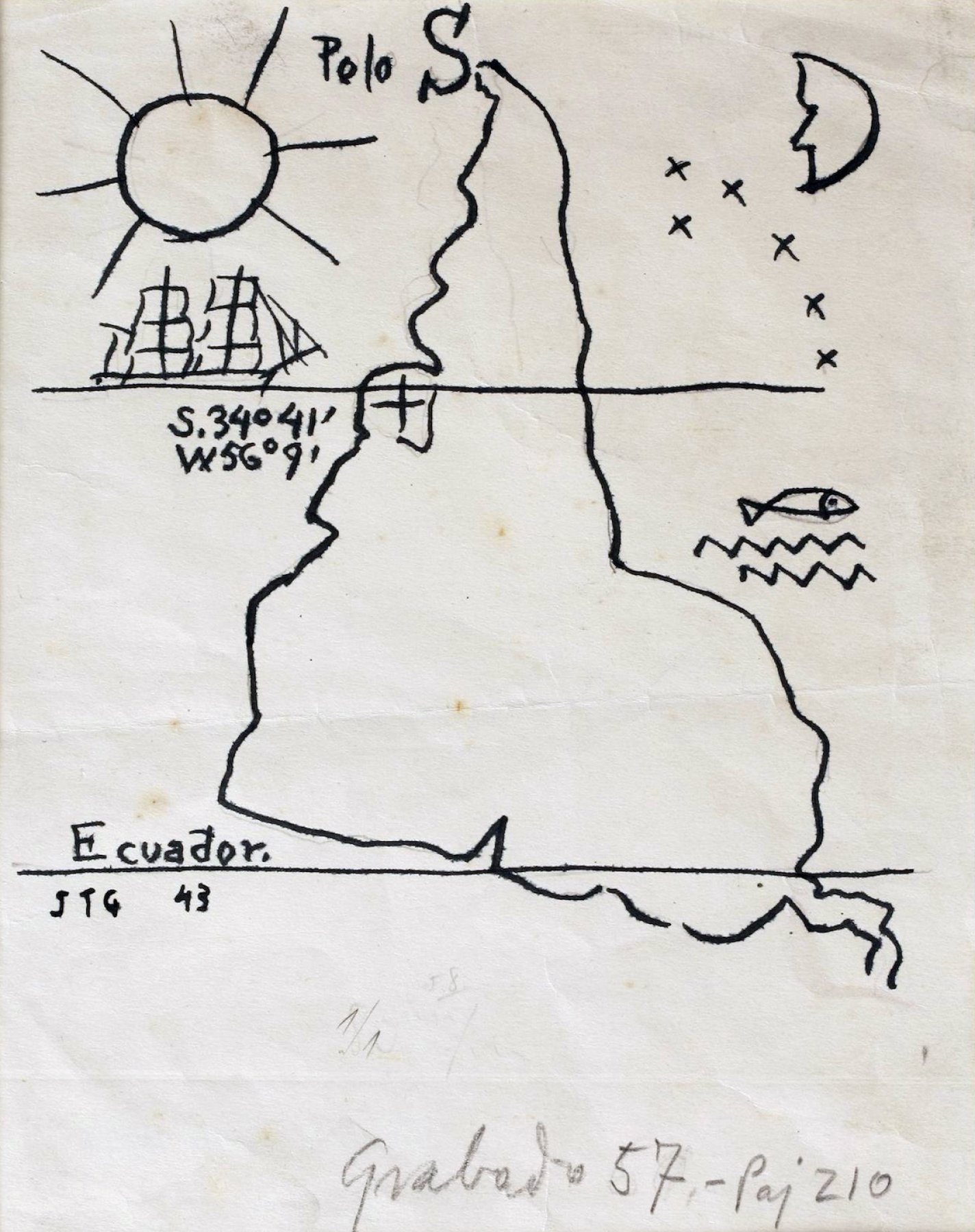
I have called this ‘The School of the South’ because in reality, our north is the South. There should be no north for us, except in opposition to our South. Therefore we now turn the map upside down, and then we have a true idea of our position, and not as the rest of the world wishes. The tip of America, from now on, extending itself, insistently points to the South, our north.
Joaquín Torres-García, La Escuela del Sur (1935)
The first time I read about autopoiesis, it struck me like an epiphany that has affected my practice as a Latin American art historian in multiple ways. The neologism, coined in the early 1970s by biologists Humberto Maturana and Francisco Varela, etymologically comes from the Greek auto (self) and poiesis (making), and it refers, in simple terms, to a system that produces and maintains itself by generating the components that produce it.1
The question that followed, borrowed from biology, was to what extent could we apply autopoiesis to the practice of art history? In other words, can an artwork be seen as a cell that produces its own system of knowledge? Considered this way, an artwork can potentially generate the terms of its own reading, and those terms can then be reprocessed, so that the artwork itself becomes a model and source of theory for the study of other artworks. I am aware that this stretches the biological concept, as a strictly autopoietic system is closed, and anything it produces for use elsewhere would, in Maturana and Varela’s terms, be allopoietic. What interests me most, however, is the principle of self-generation, the idea that the framework for reading a work need not be imported from outside it but can be drawn from the work itself.
This way of thinking became more urgent to me after I moved from Europe to “Down Under” in December 2024, as I repositioned myself in the hemisphere from which I had set out from Chile in 2008 on my journey into aesthetics and art historical research. In this process, I re-encountered Uruguayan artist Joaquín Torres-García’s drawing América Invertida, an artwork that I had often seen in my formative years in Santiago and used frequently in my teaching of Latin American architecture (particularly in relation to Amereida).2 The drawing is especially suitable for an autopoietic approach to teaching art history because of the visual and symbolic elements embedded in it, but more importantly, because this work was intended as a visual system and as a philosophical correction of the Western way of seeing the world.
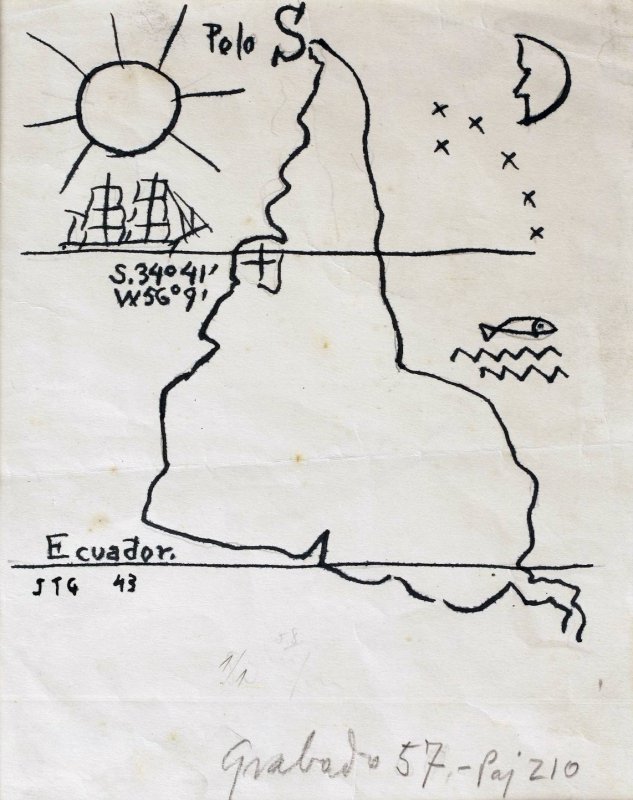
Torres-García made this small ink-outlined drawing (22 x 16 cm) in 1943 as the visual emblem of the Escuela del Sur (School of the South), a program he first set out in a 1935 lecture in Montevideo and later collected in Universalismo Constructivo (1944).3 When looked at in detail this apparently simple drawing unfolds as a conversation-in-tension between the pre-Columbian and Western Cartesian worlds, and offers a ‘philosophy of inversion’.4
At the top, the sun and the crescent moon, the latter accompanied by six small stars, can be read as Inti and Mama Killa, the sun god and moon goddess of the Andean cosmovision. Further down the page on the right is a fish above two waves, which in Torres-García’s symbolic system governs the physical plane. A sailing ship arriving in Montevideo (marked by a small cross on the upper latitude line) is both a personal token of his departure to Barcelona and his return to Uruguay in 1934, and a prominent reference to the Atlantic crossing and the colonial voyage that led to Europe’s brutal invasion of the Americas from the late fifteenth century onwards. In the world represented here, South America is at the centre, placed upside down, and the South Pole is above. At the same time, the Equator, the imaginary line that divides the globe into two equal halves, is displaced farther north. This breaks with the established cartographic North/South and ideological centre/periphery divides and disorients the Cartesian mindset by rendering the map unusable as a conventional tool of orientation. Torres-García’s theoretical call was one of radical return to an ancient order of things and an act of epistemic transgression bolstered by a self-reflective positioning, as the epigraph makes plain,
‘Therefore we now turn the map upside down, and then we have a true idea of our position, and not as the rest of the world wishes.’
Using América Invertida autopoietically entails an exercise of repositioning and re-looking, with the work itself as the blueprint. Elsewhere I have called this modality the inverted model, by which I mean an art history practised from the margins and turned upside down.5 As I conceive it, this model works as an act of transposition that encourages critical engagement with coordinates and symbols that constitute the world when it is reversed and its resulting reorganisation.
Beyond what might be assumed a priori to be an intrinsically decolonial act, the inverted model does not entail adding marginal voices or neglected artists to an existing art-historical canon, but rather, as in Torres-García’s map, of redefining the coordinates, the direction, the edges and the symbols by which the canon itself is (de)constructed. It questions the points of reference, up and down, left and right, as much as it questions the idea of the margin as ancillary to a (Euro)centre imagined as the vortex of universal knowledge.
The inverted model starts from the premise that both the centre and the margins are movable conceptual realms, in which every centre has a margin and every margin has a centre. This is a secular and open decolonial variation of Nicholas of Cusa’s theological speculation, which maintained that in the world-machine the centre was everywhere and its circumference nowhere, because he saw God (or cultural knowledge in our case) as ‘everywhere and nowhere’, as ‘circumference and centre’.6 In América Invertida, the circumference (our margin) coincides with the centre. Margin and centre move with us. The margins and “Down Under” become sites of epistemic creativity and resistance that constitute their own centres, rather than a periphery waiting to be rescued while feeding the vortex. In the same way that in Torres-García’s flipped map we can still recognise the parallels, the Equator, the coordinates of Montevideo and the essential symbols that shape the artist’s worldview, the inverted model does not start from a tabula rasa. Its task is the more problematic and challenging one of choosing what to retain and what to get rid of from an instituted reality.
To return to Maturana and Varela, the autopoietic in América Invertida resides, I would argue, more in the way of looking it produces than in the drawing itself. Used historically, every time we engage with art, we go back to the logic of Torres-García’s work and from there build a framework of our own. Researching and teaching now from Australia, where Stuart McArthur’s drawing Universal Corrective Map of the World (1979) turned the globe over once again in a gesture akin to Torres-García’s, I have become convinced that the inversion is a declaration of epistemic sovereignty in itself, the shared gesture of a tacit South-to-South alliance, that prompts us to think that, after all, and depending on where we stand, we might always have been “Up Over”.
1. Humberto R. Maturana and Francisco J. Varela, Autopoiesis and Cognition: The Realization of the Living, vol. 42 (Springer, 1980).
2. Amereida is a portmanteau of America and the Aeneid, designating a foundational 1965 transcontinental journey, a collective 1967 epic poem, and an architectural movement linking poetry and space in South America. Maxwell Woods, Politics of the Dunes (Berghahn, 2020), 85.
3. Luis Pérez Oramas et al., Joaquín Torres-García: The Arcadian Modern (The Museum of Modern Art, 2015), 28.
4. Lara Demori, Transnational Perspectives on the Art of Piero Manzoni and Hélio Oiticica: From Abstraction to Participation (Routledge, 2025), 44.
5. I first set out the inverted model in “The Inverted Model: An Argument for an Art History Upside Down and from the Margins”, paper presented at the workshop Art History, Epistemic Injustice and Ideological Violence, Kunsthistorisches Institut in Florenz, Max-Planck-Institut, Florence, October 2025.
6. Bett, Henry, Nicholas of Cusa (Methuen, 1932), 172.
Author/s: Miguel Gaete
Miguel Gaete. 2026. “Autopoiesis And The Inverted Model: A Sketch For An Art History Upside Down And From The South.” Art and Australia 61, no.2 https://artandaustralia.com/61_2/p542/autopoiesis-and-the-inverted-model-a-sketch-for-an-art-history-upside-down-and-from-the-south
Art + Australia Art + Australia ISSN 1837-2422 All content published after October 2023 by Art + Australia is available under a Attribution-NonCommercial-NoDerivs 4.0 International Licence (CC BY-NC-ND 4.0) except where otherwise stated. For more information about use and distribution you can view our Editorial Guidelines. Art + Australia is a University of Melbourne research project
Publisher: Victorian College of the Arts
University of Melbourne


