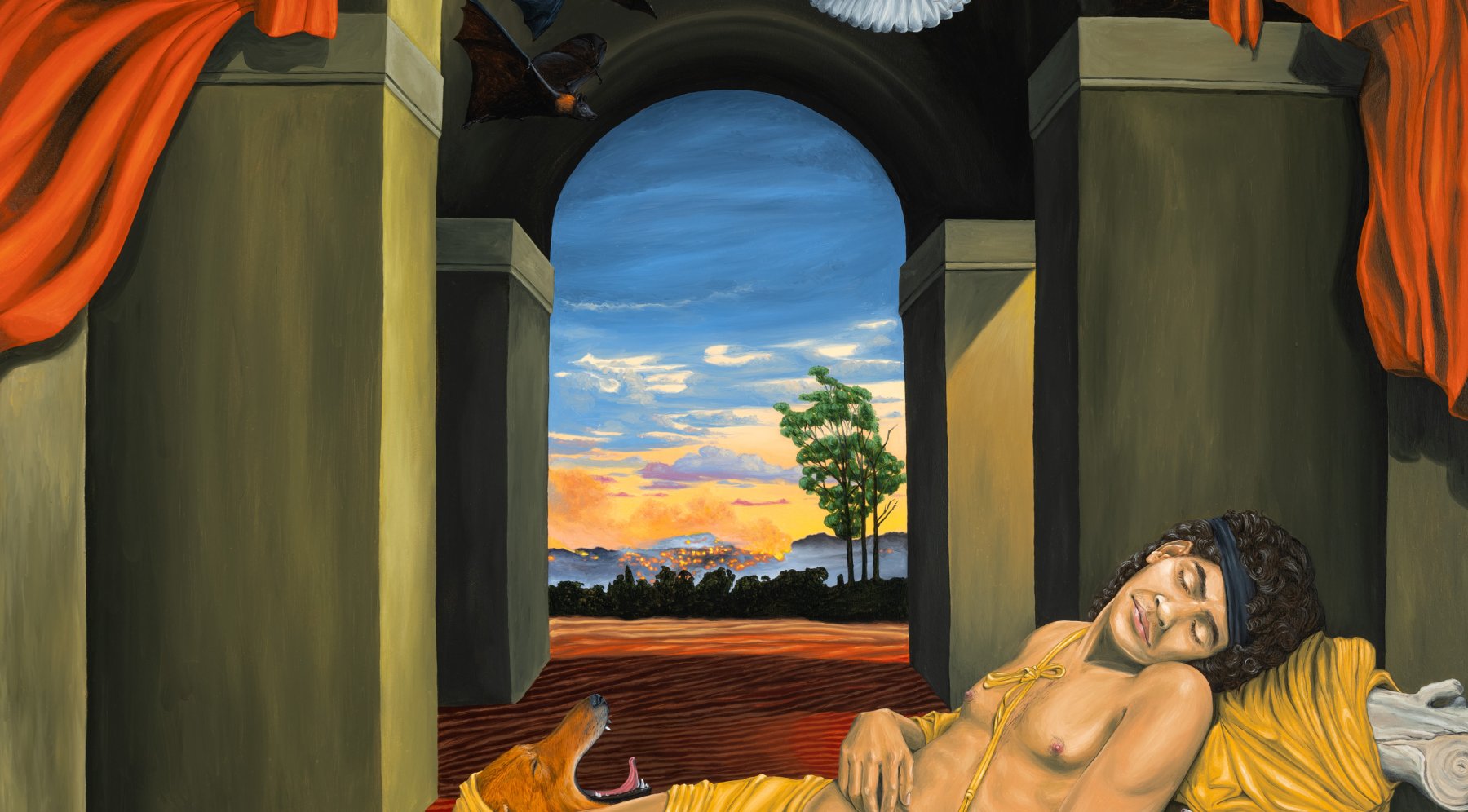
Wrested from the burgundy soil and gazing out into the littered expanse.
Much of my toil over the past two decades has been focussed on coming to terms with our shared history in Australia, and how it has shaped the configurations of contemporary society. Navigating the debris of the past, and finding treasures half-buried, has been a method I have crafted to summon some wildflowers from the ash and rubble of bygone time.
Romantic and poetic qualities have become important to my works. We live in an era where public institutions (established organisations, customs and systems created for specific social, educational or public purposes) are being undermined and disrupted through political, technological and class manipulations. There is widespread disillusionment in our perceptions of reality and a contamination of the general information an individual may receive. This condition is compounded by the degradation of our vital natural world, which is being actively desecrated to the point of collapse. In this time of yearning, precarity and revolt, I feel the qualities of Romanticism (emotion, sublimity, imagination) have renewed necessity.
My collaged defition of Romanticism, which I offer here, is that the genre contrasts beauty and ugliness to bring forward meaning through indirect and direct landings. Romanticism is a medley of reality and lived experience bleeding with waking thought, which becomes entangled with dreams that are haunted by hazy nightmares.1 Through Romantacism’s ruptured passages between dream, nightmare, reality, beauty and ugliness, we may hope to glance upon a perceived truth. The notion of truth here, although nuanced and influenced by perspective, becomes all the more important to think through and feel when humanity is unilaterally or bilaterally damaged.
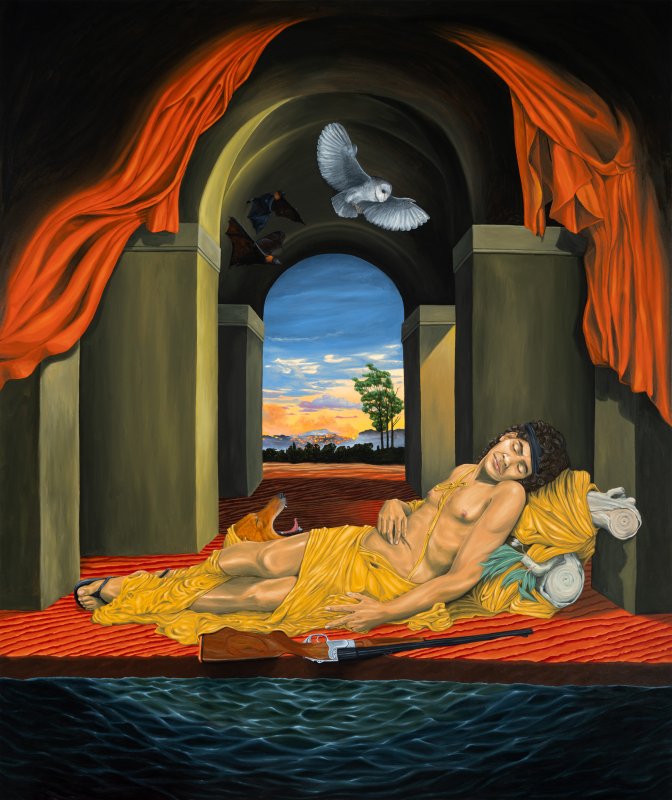
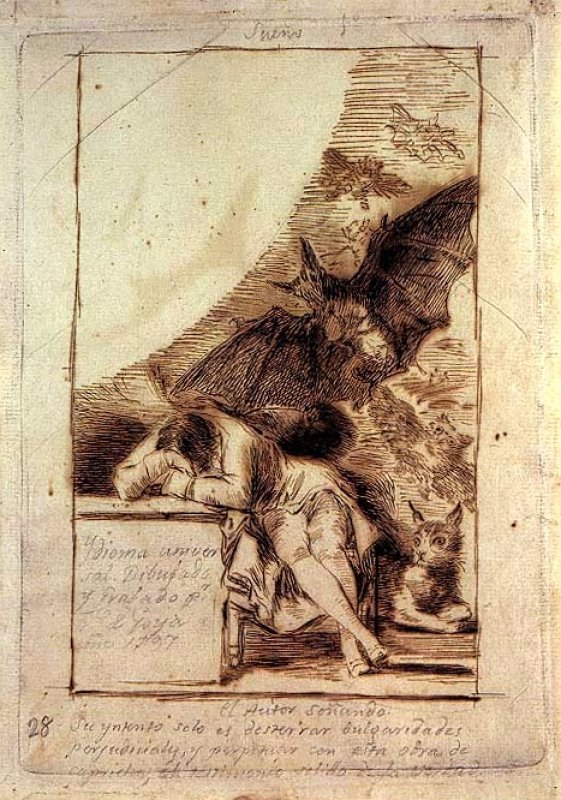
The artwork accompanying this issue, Our lifestyle of tranquillity undisturbed (2026), is a dreamscape that meditates on a slogan in George Orwell’s 1984, ‘who controls the past controls the future: who controls the present controls the past’.2 The protagonist in the painting lies peacefully, accompanied by a loyal companion and a luxury rifle on the precarious edge of dark, reflective water that ripples at the threshold. In the background, a large bushfire sparks and stirs. The reclining figure is surrounded by large stone pylons and a cavernous archway that shimmer in a spotlight hue and recede into a deep shadow. Emerging from the indoor peaks, flutter two flying foxes and a white owl. One interpretation I offer of the animals’ presence is that they reference Francisco de Goya’s series Los Caprichos, in particular his etching, El sueño de la razón produce monstruos (1799).
In Goya’s drafts for this etching, there is a version, similarly composed, that bears the title Idioma universal (or Universal language), with a handwritten caption that reads,
The Author dreaming. His only intention is to banish those prejudicial vulgarities and to perpetuate with this work of caprichos the sound testimony of truth.3
This is what interests me about Goya’s work. Aside from his skill as an artist, I’m taken by his critique and social commentary. These are truthful elements that emerge from his dazzlingly beautiful yet horrific compositions that continue to reflect our present moment. It is a present intrinsically shaped by days gone by and one that will continually inform days to come. Goya’s approach, his commentary on his own time and its persistent relevance, continues to be a strong influence on the way I approach the different layers of my recent works.
The title of the work Our lifestyle of tranquillity undisturbed also toys with romanticised ideals. It is a mélange, sampled partially from Captain Cook’s earliest observations that Aboriginal people ‘live in a tranquillity which is not disturb’d by the Inequality of Condition’.4 Cook’s paternalistic claim erased complex cultural, social and political realities that existed in and between Aboriginal nations; realities which, in many forms, continue to persist. Cook later personally fired his gun upon two Aboriginal men at Kamay, a site he would name Botany Bay, before he even set foot on the land. The second sample in the title is from former Prime Minister Tony Abbott, who over two centuries later in 2015, described life in remote Aboriginal communities as a ‘lifestyle choice’ that ‘should not be funded by the Australian taxpayer’.5 These statements are blended in the title and referenced in the work to point to enduring cultural attitudes upheld within the body politic of colonial Australia towards Aboriginal peoples.
Our lifestyle of tranquillity undisturbed positions artistic movements of the Western canon—particularly Romanticism and the Renaissance—as something locally inherited rather than revered from afar. I approach the Renaissance as a method where I excavate objects and ideas from the past, which are carefully recontextualised and redeployed as foundations for renewed artistic inquiry and collective imagination. In this sense, these fragments are held together by a fragile hope for social flourishing, whereby life expectancy is taken for granted, food and housing is attainable, medicine and medical treatment is accessible, and cultural and land rights are safe, protected and celebrated.
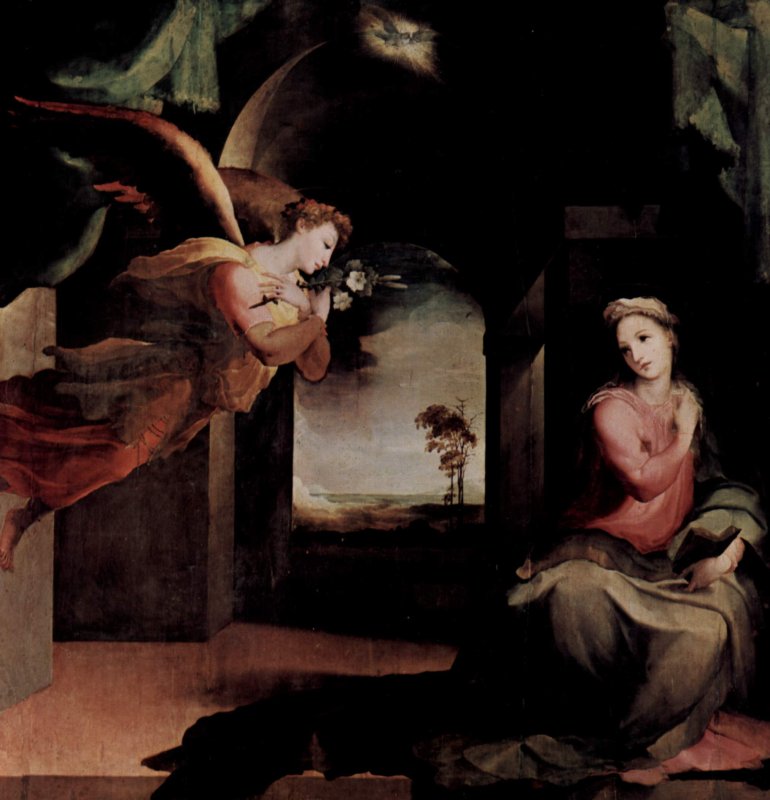
Another key reference in this painting is Domenico Beccafumi’s The Annunciation (c. 1545-46). One of the artist’s later works, The Annunciation employs chiaroscuro: a technique that contrasts lightness and darkness. Beccafumi’s work depicts two figures bathed in light against a deep, dense shadow that ascends the barrel-vaulted chamber. His painting has the melodrama of similar religious works that portray the theological event when the archangel Gabriel visits the Virgin Mary to enlighten her of the fact that she will bear the son of God, Jesus Christ. Amid the painting’s melodrama, there is also grace, as a shadowed, bittersweet intimacy imbues the sense of weight this news bears. Beccafumi’s darkened chamber is central to delivering the encounter’s sense of grand entombment; it is part spectacle and part secretive seclusion. I view this architectural element as emulating the chambers of the heart, the mind, body and soul. Our lifestyle of tranquillity undisturbed takes this reading of the chamber as an allegory of humanity as is its point of departure. Here, it evokes the thresholds in all our lives that both restrict and free us, and that we all must cross.
Renaissance themes in Our lifestyle of tranquillity undisturbed are revived and echoed in layers that, at times, reflect back onto their own resonance. The central figure is no longer modelled on Christian theology but on the mythic figure of Adonis, and references Antonio Corradini’s post-Renaissance eighteenth century sculpture Adonis (c. 1723-25) and its corresponding tale with themes of love, sensuality, stubbornness, drive, mortality, tragedy and longing. Adonis is an archetype of youthful masculinity and beauty. According to the myth, he left the embrace of his lover Venus to pursue a boar in a hunt of sport. A leisure that cost him his life, Adonis thus became a symbolic figure of potential, exemplified by the brash end to his short life. Earlier Classical developments of the Adonis myth refer to symbolism of cut vegetation, cut short or short lived.6
The protagonist in Our lifestyle of tranquillity undisturbed lies in apparent relaxation, with his head cradled by cut eucalypt branches. The bright red curtains are parted, and the central figure is theatrically illuminated; here we bear witness to a story that continues to unfold. The water laps at the near edge. The figure is solitary apart from his canine companion, which departs from depictions of Adonis in Titian’s Venus and Adonis (c. 1550s) and Departure of Adonis (c. 1553-54), where he is seen with his lover Venus. Titian similarly departed in his depiction of Adonis, in his case from Ovid’s recitation in Metamorphoses, instead likely modelling his work on the antique relief The Bed of Polyclitus that depicts Psyche and Cupid.7 This is evidenced in Titian’s drawn studies of the carving, as well as preceding works by Michelangelo and Rosso Fiorentino who both altered their copies of Polyclitus’s Cupid from The Bed of Polyclitus, Christianising him as the basis for depicting Jesus Christ’s entombment.8
Here too, in this new work, there are continued ripples of lament and longing. Instead of representing the death of a god-like Adonis or Jesus, it is the ambiguous mortality of an Aboriginal ‘everyman’: an ‘everyman’ that still displays a lived presence and inner life. He is a figure who reverberates with the echoes of families that have been shattered over the past few centuries and the continued incarceration of our children, sometimes as young as ten years old, frequently experiencing solitary confinement.9 Recent governments in both the Northern Territory and Queensland have run successful election campaigns on policies advocating harsher approaches to the incarceration of children and even lowering the age of criminal responsibility.10 The unfortunate public reception to these successful campaigns has given these governments a perceived mandate to not only enact these policies, but has also emboldened them to pursue increasingly draconian responses. Here, threads of the Renaissance become more definite.
Our lifestyle of tranquillity undisturbed is part of a dialogue that has room for translation and shared understanding. By using iconography, a common visual language this shared understanding and the capacity for truth to emerge is made possible. I believe works of art can help us make sense of our past and present, which may allow us to cross fault lines that I have seen shift in recent times. Themes of destruction and rebirth in my painting hint that there must be some hope for improvement, there must be some value in our past, and cultures that can be adapted and accentuated with the knowledge and experience of our present. The unearthing of truth, reason and inspiration could bring us to a period of flourishing once more. This is not a dream for some pre-colonial utopia, but to take from the past what may still serve and strengthen us. My commentary on the present points to history’s endurance, and seeks to meaningfully contribute to both the direction of our communities and the work-in-progress that is the Australian project. That way, we may be a part of shaping and strengthening our shared institutions, and not simply be in danger of them, at their mercy or subject to their failures.
1. Simon Gregg, New Romantics: Darkness and Light in Australian Art, Australian Scholarly Publishing, North Melbourne, 2011.
2. George Orwell, 1984: A Novel, Signet Classics, New York, 1949, p. 32.
3. In Janis Tomlinson, Francisco Goya y Lucientes, 1746-1828, Phaidon Press, New York, pp. 128-34.
4. James Cook, Journal of H.M.S. Endeavour, 1768-1771, MS 1, National Library of Australia, Canberra, https://nla.gov.au/nla.obj-228958440.
5. In Tom McCarthy, ‘Tony Abbott's Indigenous “lifestyle choices” remark smacks of racism, says UN rapporteur’, The Guardian, 29 April 2015, https://www.theguardian.com/australia-news/2015/apr/29/tony-abbotts-indigenous-lifestyle-choices-remark-smacks-of-racism-says-un-rapporteur, accessed 5 October 2026.
6. Jay Reed, ‘The Fruits of Adonis’, Philologus, vol. 149, no. 2, 2005, pp. 362-64.
7. Ovid, Metamorphoses: The New, Annotated Edition, trans. Rolfe Humphries, annotated J.D. Reed, Indiana University Press, Bloomington, 2018, Book X, 503–end.
8. David Rosand, ‘The Passion of Adonis’, Arion: A Journal of Humanities and the Classics, vol. 21, no. 3, 2014), pp. 5-27.
9. Annabel Henessy, ‘Australia Jailing Children as Young as 10: Northern Territory Lowers Age of Criminal Responsibility, Human Rights Watch, 21 October 2024, https://www.hrw.org/news/2024/10/21/australia-jailing-children-young-10, accessed 6 October 2026.
10. Hannah Ritchie, ‘Children as young as 10 will face adult jail time in Australian state, BBC News, 12 December 2024, https://www.bbc.com/news/articles/clyj6dd1zdro; and Andrew Messenger, ‘Queensland children as young as 10 could face life in prison for non-violent crime under new laws’, The Guardian, 1 April 2025, https://www.theguardian.com/australia-news/2025/apr/01/queensland-children-as-young-as-10-could-face-life-in-prison-for-non-violent-under-new-laws, both accessed 6 October 2026.
Author/s: Ryan Presley
Ryan Presley. 2026. “Wildflowers Amongst The Ashes.” Art and Australia 61, no.2 https://artandaustralia.com/61_2/p555/wildflowers-amongst-the-ashes
Art + Australia Art + Australia ISSN 1837-2422 All content published after October 2023 by Art + Australia is available under a Attribution-NonCommercial-NoDerivs 4.0 International Licence (CC BY-NC-ND 4.0) except where otherwise stated. For more information about use and distribution you can view our Editorial Guidelines. Art + Australia is a University of Melbourne research project
Publisher: Victorian College of the Arts
University of Melbourne


