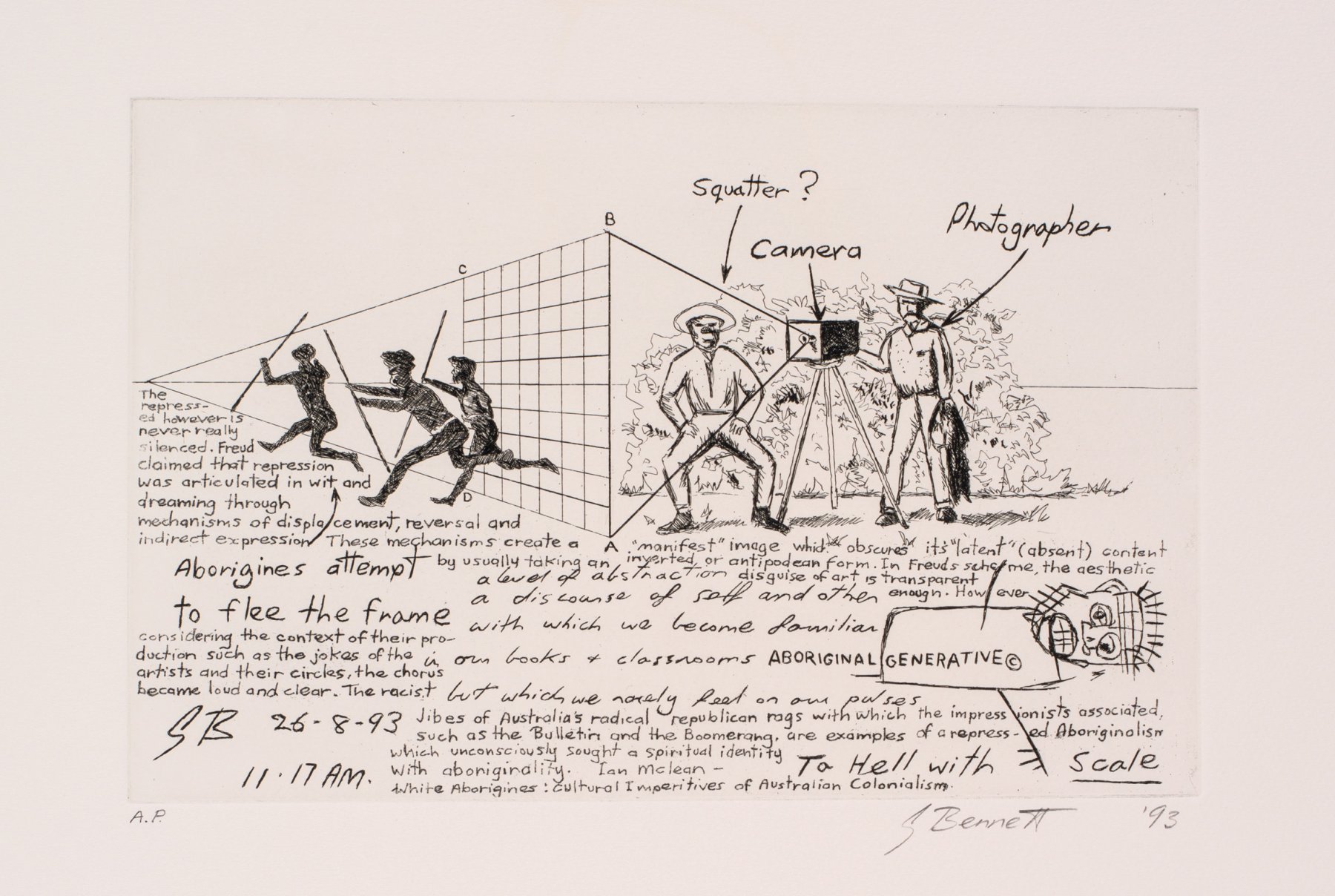
Words by
Gordon Bennett,compiled byMichael Gentle
'In Australia, the dominant system of Identification begins with the "discovery" of the continent by Captain James Cook. It continues with the "exploration" and "pioneer settlement" of a seemingly empty land. Today, the "pioneer spirit" and "rugged outback image" are still evoked as the identity all Australians share, even though majority of Australians live in cities in one of the most urbanised countries in the world.'1
'When Captain James Cook first set eyes on Australian shores, he carried with him his cultural baggage that positioned him and his culture at a point along the teleological perspective lines of history.'2
'One projects onto Landscape what one thinks one sees (from within in the prison of Language and cultural conditioning) not what is there what is there is beyond human conscioness sic until it is contained / categorised, limited by language + cultural reference, belief, etc.'3
'The same but different / different but the same / the same but different / different but the same / authentic /
notauthentic / authentic /notauthentic / authentic /notauthentic / original /notoriginal / original /notoriginal / original /notoriginal'4
'The text can get inside a person’s head. A viewer will invariably recite the text in their minds.'5
'What the mind constructs is based on the past learnt experience of cultural conditioning and culturally relative knowledge.'6
'... I think it might come down to the work of artists being appropriated by critics and theorists to meet their own ends. Pollock was appropriated to fit the agenda of critics like Clement Greenberg, which we went along with, of course, and it made him very famous, but it was not of his making.'7
'... it was the same with Paul Taylor’s Popism – The Art of White Aborigines. I think it’s a mistake when artists start to believe all that stuff and start calling themselves "White Aborigines", and really taking that stuff seriously.'8
'In fact, the myths of popular "primitivism" in relation to contemporary Australian Aboriginal art, and the notions of the "spiritual" and "authentic", are still widely used to exclude and marginalise the work of artists of Aboriginal descent.'9
'Aboriginal cultures are among the world’s most ancient and impressive cultures, incorporating a subtle, complex and rich way of life.'10
'...some conservative politicians dismiss such expressions or any support for an Aboriginal perspective as part of a "guilt industry."'11
'I guess the same can be said for the naming of products after Australian native species. At the heart of this then is a kind of cultural and identity appropriation, like boomerangs used to indicate an authentic "Australianess" {sic} or the use of Native American cultures as authentically American.'12
'By placing such cultural baggage, memories, traditions, abstract representations or whatever in the culture {drawer} of one’s dressing table, an individual may accumulate points/sites of reference or identification. They dress themselves.'14
'Perhaps Australia, on a collective level, can become a more whole, more mature country by accepting the "skeletons in the closet" instead of denying they ever existed. Denying the history of abuse means not being able to face it and thus not being able to understand current issues such as land rights in their full context, or in the clear light of reason, free of guilt. Until Australia comes to terms with itself and its fabricated identity based on the false ethnocentric notion of terra nullius, it will only ever be half a nation.'15
'Europeans will not find their “lost” primitive roots in Aboriginal cultures either. They will only find the reflection of themselves.'16
'removal / abstraction / avulsion / deracination / dislodgement / eradication / exsection / extirpation / extraction / purge / remotion / remove / ripping out / shift / stripping / uprooting / withdrawal'17
'Australia’s racist underbelly remains exposed.'18
'We learn Hurt from the aggressions, the bruises and we learn to live exist among them / recall, create AND construct realities from chaos.'19
'I feel saddened, and not a little disgusted, that these people expect Aboriginal people to keep quiet about our history, quiet about our experiences. And to those who dare break the "white blanket" of silence are directed the emotional accusations of "moralising", as if morality is a dirty word and has no place in art.'20
'Your suggestion requires a tremendous amount of trust (or gullibility) on my part so please forgive me if my fears are unfounded but the fact remains that I don’t know you…'21
1. Aesthetics and Iconography: An Artist’s Approach, Aratjara: The Art of First Australians (Cologne: DuMont Buchverlag, 1993), p. 17 (in Gordon Bennett: Selected Writings)
2. Gordon Bennett, The Manifest Toe, in The Art of Gordon Bennett, p. 50
3. Gordon Bennett, Metaphysical landscape (To the sound of cicadas) no. 3, 1990, oil and synthetic polymer paint on canvas, 136.5 x 240.9, National Gallery of Victoria, Melbourne/
4. Notes to Basquiat (Ab)original, 1998, synthetic polymer paint on paper, 120 x 80 cm, Griffith University Art Collection, Donated through the Australian Government’s Cultural Gifts Program by Dr Paul Eliadis, 2011.
5. Gordon Bennett, Letter to Ian McLean ‘Notes to Basquiat’ 4 April 2001, in Gordon Bennett: Selected Writings, p. 106.
6. Gordon Bennett, The Manifest Toe, in The Art of Gordon Bennett, p. 47
7. Interview with Gordon Bennett, Chis McAullife, p. 133
8. Ibid., 133
9. Gordon Bennett, Cloud Gazing, in Breaking Borders (Winnipeg St. Norbet Arts Centre, 1997), p. 63
10. Gordon Bennett, Aesthetics and Iconography: An Artist’s Approach, Aratjara: The Art of First Australians (Cologne: DuMont Buchverlag, 1993), p.29
11. Gordon Bennett, Artist’s Statement: A Non-Apology, unpublished, 1993, p. 33
12. Gordon Bennett, Letter to Ian McLean ‘Notes to Basquiat’ 4 April 2001, in Gordon Bennett: Selected Writings, p. 105
13. Gordon Bennett, Untitled (dismay, displace, disperse, dispirit, display, dismiss), 1989, oil and synthetic polymer paint on canvas, 6 parts: each 30 x 30cm, Museum of Contemporary Art, Sydney
14. Gordon Bennett, “Letter to Rose Johnson, 3 October 1996,” p. 98
15. “Gordon Bennett: Expressions of Constructed Identity. Interview with Anne Kirker,” Artlink 10, no. 1 & 2 (1990): 93-95, p. 126
16. Letter to Dr Hans Werner V. Kittlitz, November 15, 1992, typed letter, Archive of Gordon Bennett.
17. Gordon Bennett, Notes to Basquiat: Poet and Muse, 2000, acrylic on canvas, 152.5 x 182.8 cm, National Gallery of Victoria, Melbourne.
18. Gordon Bennett, Artist’s statement: Eddie Mabo (after Mike Kelley’s Booth’s Puddle, 1985, from Plato’s Cave, Rothko’s Chapel, Lincoln’s Profile, p. 59
19. Gordon Bennett, Kierkegaard, 1995, synthetic polymer paint, charcoal, ball point pen, 56.5 x 38.5 cm, National Gallery of Victoria.
20. Gordon Bennett, “The Manifest Toe”, in Gordon Bennett: Selected Writings, p. 53
21. Gordon Bennett, Ricochets; Manifest Destiny (A Painting for the Distant Future); and Window onto a Shadow Universe, 1993, mixed media installation, dimensions variable, The Estate of Gordon Bennett; the text here is sourced from the artwork which replicates a fax exchange between Gordon Bennett and Imants Tillers, this is Bennett’s reply to Tillers suggesting a telepathic collaboration between the two.
Author/s: Michael Gentle
Michael Gentle. 2026. “Terra Nullius (teaching Aid) As Far As The Eye Can See (1993).” Art and Australia 61, no.2 https://artandaustralia.com/61_2/p565/terra-nullius-teaching-aid-as-far-as-the-eye-can-see-1993
Art + Australia Art + Australia ISSN 1837-2422 All content published after October 2023 by Art + Australia is available under a Attribution-NonCommercial-NoDerivs 4.0 International Licence (CC BY-NC-ND 4.0) except where otherwise stated. For more information about use and distribution you can view our Editorial Guidelines. Art + Australia is a University of Melbourne research project
Publisher: Victorian College of the Arts
University of Melbourne


