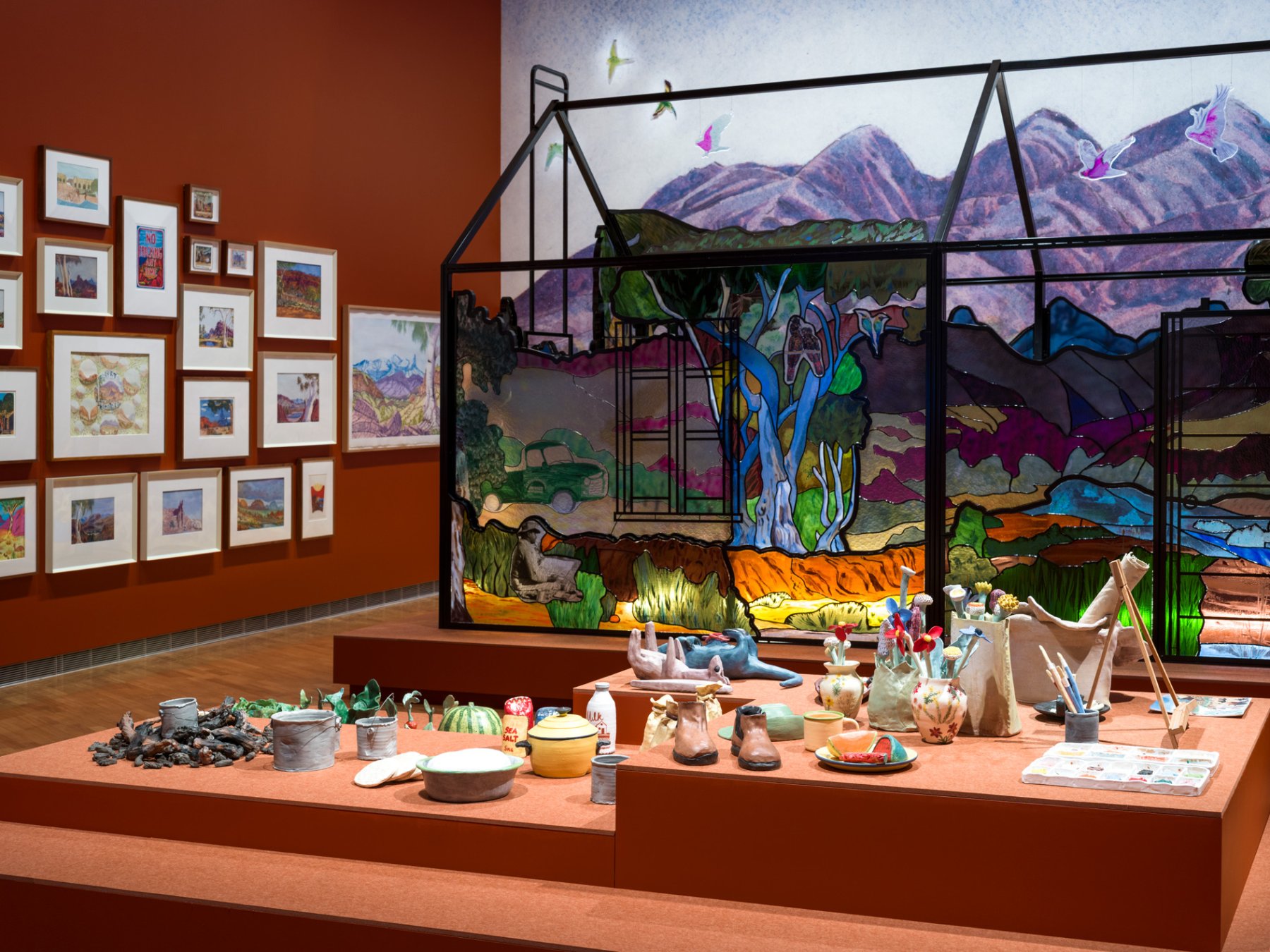
In a moment between his curatorial project After the Rain at the National Gallery in Canberra/Kamberri, and the launch of his major solo exhibition Not a Souvenir at the Museum of Contemporary Art in Sydney/Gadigal, Tony Albert travelled to Melbourne/Naarm to be ‘in residence’ at the University of Melbourne’s Art History and Art Curatorship program, and to share his insights and experiences with the broader art loving public.
In this interview we consider the role of artists and curators in shaping art histories. If, as Andrew Sayers once stated, curators have been instrumental in creating shapes for histories of Australian art, then how, in turn, have artists shaped—and even unshaped—these art histories.1 Albert’s experience working in and across both worlds provides pause for thought, and garners many a delightful anecdote. Together we cover topics such as collection representation, decolonisiation, collaboration, leadership, institutional change and the art of relinquishing control. In our work we are both committed to the artist leading the way, into collections, exhibition-making and into art history.
Lisa Slade (LS): I am thrilled to have this opportunity to open a conversation with you about your practice, and to explore the space between being an artist and a curator.
This is an interesting time in your career. We’re in the final days of the 5th National Indigenous Art Triennial: After the Rain at the National Gallery of Australia, which you have curated donning the hat of Artistic Director, and next month in May, you return to being an artist again as the focus of the exhibition Not a Souvenir at the Museum of Contemporary Art in Sydney. I would like you to take us on a journey to consider what it means to take on the mantle of those roles. Let’s start here at the National Gallery of Victoria (NGV) with your work on display in Wurrdha Marra where it is in conversation with the work of Brook Andrew, Warraba Weatherall and Yhonnie Scarce. This underscores for me, as a curator, the importance of bringing works by artists, first and foremost First Nations artists, into collections. I'm curious about what it means to have your work collected. Can you articulate for us, the importance of being collected as an artist?
Tony Albert (TA): My first work acquired by a national institution was Headhunter (2007), which was purchased by Hetti Perkins, then Senior Curator of Aboriginal and Torres Strait Islander Art at the Art Gallery of New South Wales. It was such an incredible feeling to have the work enter their collection. It’s not the most important thing as an artist, but there is a lot of dedication involved in making art, and having your work sit alongside the heroes in your life, and feeling part of that community, is deeply validating.
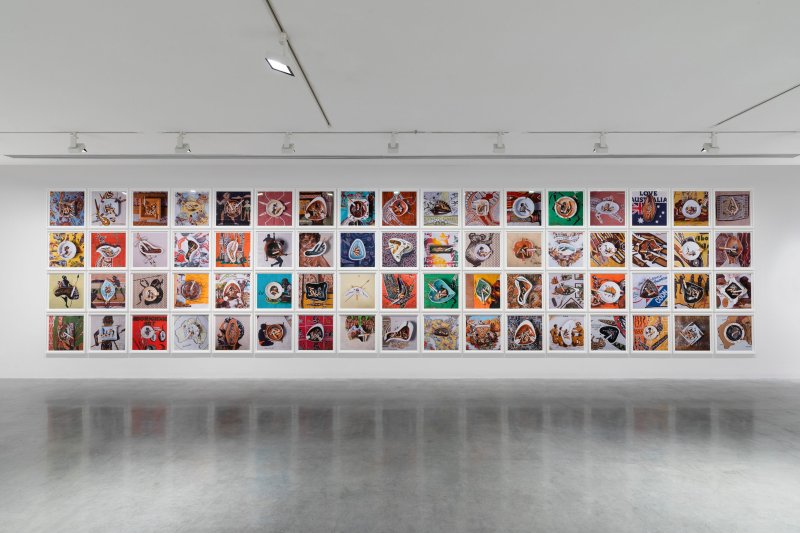
The etchings on display in Wurrdha Marra are from my Ash on Me series (2015). They are not the most seminal work of my career, but to see them framed and displayed as a series in the Gallery evoked a memory from a special time in my life. I made them in the print studio at the College of Fine Arts (now the School of Art & Design, University of New South Wales) where on Fridays, printmaker Michael Kempson and then Director of Indigenous Programs Tess Allas would invite artists to work: Reg Mombassa, Fiona Foley, Reko Rennie, Ryan Presley, Vernon Ah Kee and Brenda L. Croft were some of the artists involved.2 Visiting artists would work with printmaking students who, as part of their studies, were required to complete a certain number of studio hours, and they supported the artists by assisting with the printing of their work, and in return each student received a print. I thought it was a wonderful program, and this ethos of community and mentorship is ingrained within me. It was my Friday of solace, so it was a bit nostalgic seeing the works here at the NGV, and maybe they’re a bit more important than I realised at the time.
LS: Printmaking is a generative medium that is ultimately about generosity, which accords with your way of working, your practice and your sensibility. You’re one of the most generous people I’ve worked with in the art world, and one of the most generative, and I think one of the reasons you work so well across the continuum from artist to curator is because you see the capacity of so many others. What is one piece of advice you have for curators?
TA: Firstly, if you’re an artist and curator, don’t ever put your own work in your own show. Secondly, trust the artist and give the artist autonomy to answer your questions. I lean on the curator a bit and ask for parameters, otherwise I'm going to come back with something that is not even remotely attached to the thematic of the show. As a curator, once you hone in on the thematic, let the artist go for it and the outcome will be bigger, better and more amazing than intervening in their process and holding onto fear. I have found that artists won’t do what you ask them to do, but they will do something better, so let go of fear.
LS: Embrace love and let go of fear. Let’s use this bridge that you’ve just built for us, the notion of following the artist, to think about your work as Artistic Director for After the Rain. You brought a level of integrity and engagement that ran through every single part of the process, and you changed that institution as part of that journey. Talk us through your approach to taking on the role.
TA: From 2000–08, I worked at the Queensland Art Gallery (QAG), which people either don’t know or don’t consider as part of my practice. I felt very fortunate to already have insight into institutional ways of working. I left QAG when I had to make a choice to either exhibit in a show as an artist or work on the show.3 I took a leap of faith to give everything I could to my own practice, which was a defining moment for me, and I have been so grateful for the time I have been able to give to my work and for all that has come out of that.
The embers of the fire of working on the After the Rain were sparked as a Curatorial Fellow at the Fondation Cartier where I was involved in commissioning fourteen new artworks by First Nations artists for the 24th Biennale of Sydney: Ten Thousand Suns (2024).4 A fire was lit under me during these two years and I recovered my passion for working with artists, as well as my vocabulary within institutional spaces: how to push, challenge and navigate them. In December 2024, Nick Mitzevich, the Director of the National Gallery of Australia (NGA), invited me to be the Artistic Director of the 5th Indigenous Triennial. My immediate response was that it would be amazing, but there were many things I wanted to consider and discuss with Nick before saying yes. If this was to be the first artist-led Triennial, then why chose me, when there are incredible First Nations curators who study art history and do extraordinary curatorial work? There were also institutional changes that needed to happen; for instance, the Triennial has not been consistently held every three years, so I needed a commitment that the NGA either change the name or make it every three years.
I didn’t want to step into the role feeling uncomfortable or lacking confidence, so I also had to consider my contribution to its legacy. Brenda L. Croft curated the 1st Indigenous Triennial: Culture Warriors, which was such an important moment of recognition for contemporary Indigenous art in the form of a triennial. I was living in Brisbane at the time, and I didn’t have a dollar to my name, but I saved up to travel to Canberra. I was included as an artist in the 2nd Indigenous Triennial: unDisclosed and the 3rd Indigenous Triennial: Defying Empire, which was a dream come true. The 4th Triennial: Ceremony was curated by Hetti Perkins, my mentor in art and life. So, I thought: ‘I can do this, this is part of my story’, and I felt like the right person for the job.
One of the first decisions I made for the 5th Triennial was limiting the number of projects to ten and I brought in philanthropic enterprise so that we could allocate more time, energy and resources to a smaller number of artists. This was important for my own experience but also because there is never enough time, energy or resources. As an artist, you have a production budget fee and an artist fee, but you always end up eating away at your artist fee, which is meant to be for your rent and food. I told the artists not to spend their artist fee on anything but themselves and to come and talk to me if they were considering spending their artist fee on the production of the work.
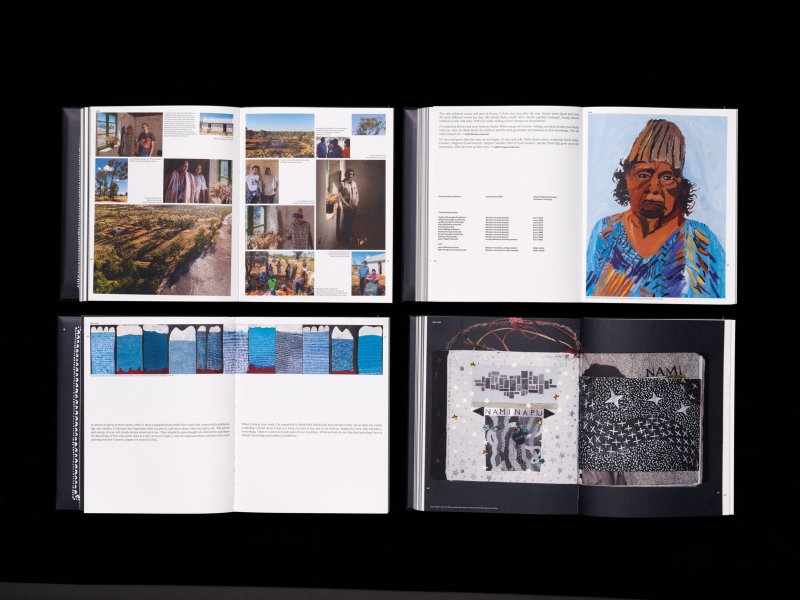
It was important to me that the artists were involved in every single step in the process. Curators are usually the conduit between the institution and the artists, which means you have people working in other roles in these institutions who have never directly worked with an artist. Artists should infiltrate these spaces, and not just with their art: they should be back of house too. Aretha Brown did the branding and the digital assets for the exhibition, and Vincent Namatjira painted portraits of every artist in the show, so instead of using photos by the institution for publicity material, we had images of the artists painted by another artist. Having artists involved so closely in the process meant that everyone felt that they were part of the journey. This wasn’t a show where I'd seen a work at another institution or in the artist’s studio and said ‘let's put this in’; I spoke with each artist about what After the Rain means, and over two years, these projects grew. I was fortunate to be in a position where all the ingredients were right to elevate the artists and their work.
I’ve just been informed that After the Rain will be travelling nationally. Many venues requested the exhibition, the largest volume ever for the National Gallery, which was so heartwarming. Having these conversations early on was important to understanding how the touring aspect was crucial. The NGA’s ‘Sharing the National Collection’ initiative is something I find extraordinary. During my time at QAG, there was a reluctance and hesitation to share ‘good’ works with other galleries because of risk and the paternalism at play, which is often the case in major institutions. Recently, there has been a Monet from the NGA collection at the Tweed Regional Gallery and there was a Warhol show just outside of Perth at the Wanneroo Regional Gallery where visitation went up 754 per cent. The National Collection is owned by all of us, and extending access and a sense of ownership to communities across the country through regional venues should be recognised and applauded. We should think more sustainably about our collections and shared custodianship over works within institutions. I don’t understand why we would have 2000 Yayoi Kusama balls in one institution and 2000 in another? Just share them!
LS: After the Rain is a love letter to each of the artists you’ve worked with, and it is also a love letter from the artists back to you. Each room holds a very important relationship at its core, and I would like you to tell us about how you enabled Albert Namatjira’s return to community in the House of Namatjira.
TA: Selecting Albert Namatjira was one of the biggest emotional roller coaster rides for me because he is such a hero. I wanted to be sustainable in my thinking, and I wanted to show works from the NGA collection that have never been seen before, I couldn’t resist the fact that the NGA has just under a hundred works by Namatjira.
It was very clear to me early that telling Albert’s story meant including Iltja Ntjarra Many Hands Art Centre, the Hermannsburg Potters, and Vincent Namatjira, his great grandson, all of whom have their own story in their own right, but who are also testimony to Namatjira’s legacy. We started with consultation at Tjuwanpa Outstation Resource Centre, just outside of Ntaria/Hermannsburg, where Rex Battarbee and Albert first met, and brought all the family together. I had assumed that artists at art centres would see each other more often, but I very quickly realised while doing Zoom calls that this isn’t a common occurrence. At Tjuwanpa, people were gossiping and sharing stories; you could see the passion and love for the potters who were teaching clay work to the watercolourists, and vice versa. Vincent did a presentation of his work, and there was so much love and awe for him: he really is a rock star. It was clear that we all needed to be in the same space at the same time.
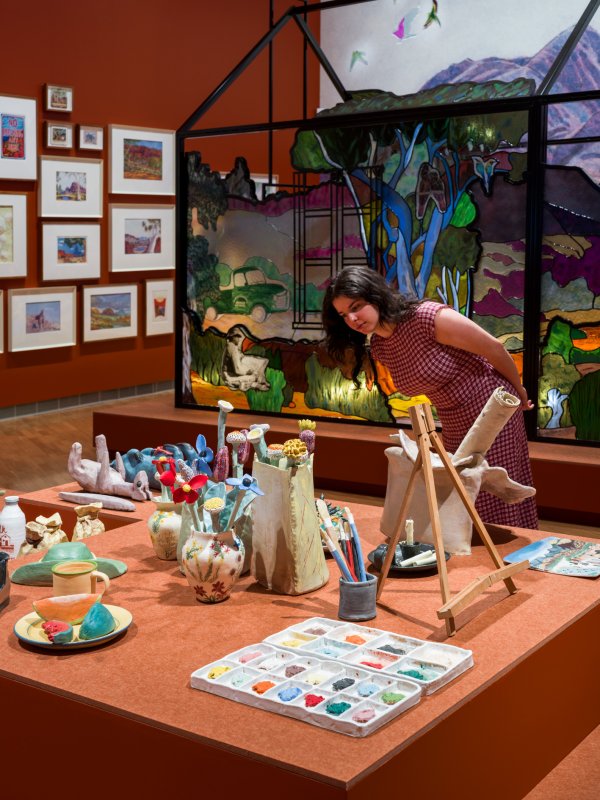
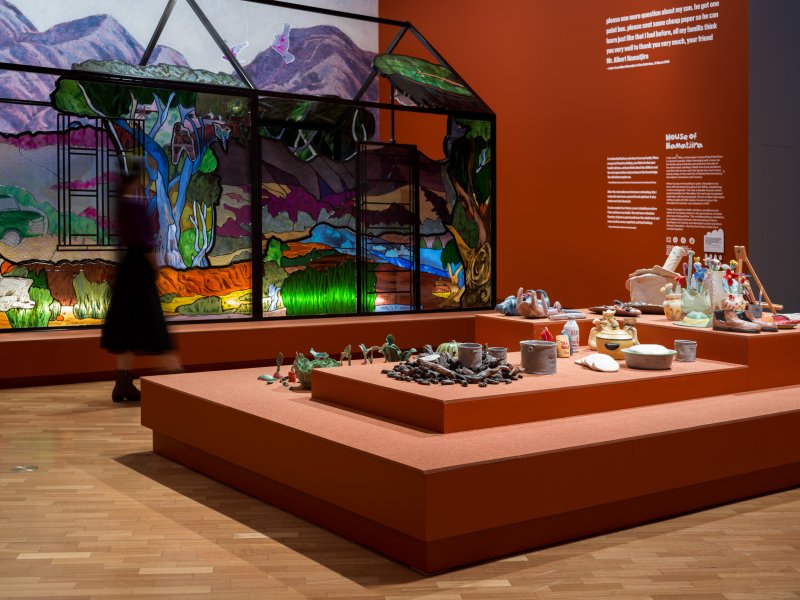
The idea of grounding that space and place in the exhibition by reproducing Albert’s house in some way, shape or form became seminal in the bigger, broader project of the House of Namatjira during this consultation. On this trip, after twenty years of visiting Ntaria, I visited Albert’s house for the first time. I didn’t even know it existed and I was like: ‘why isn’t this more widely known?’ Albert was the first Aboriginal person to be given citizenship in this country, long before the 1967 Referendum. In his lifetime, he was a celebrity known across the country, the most reproduced Australian artist in history, and he was such an incredible entrepreneur who wanted so much better for himself and his family. After being given citizenship, Albert applied for land grants in Alice Springs and in Darwin and was denied each time. His answer to this was to build his own house on the edge of the Larapinta/Finke River, which is the oldest river in the world, right in the middle of the desert.
I have visited Frida Kahlo’s house in Mexico City and Basquiat’s apartment in New York City and when you visit an artist’s home, you really get a sense of who they are and what defines them. I wanted to tell Albert’s incredible story through the lens of his house as the living, breathing and pulsating heart of the community. The opportunity to work with the community to rebuild the house came about when Canberra Glassworks came on board and suggested making a to-scale reproduction of the house in stained glass. The glass was left over from a project at the Araluen Arts Centre in Mparntwe/Alice Springs by a very senior Elder of the community and incredible watercolourist Wenten Rubuntja, the father of Mervyn Rubuntja and a dear friend of Albert. The leftover glass was gifted to the Glassworks and for about 50 years has been sitting there, waiting for the right project. How phenomenal.
For the first time, the Hermannsburg Potters deviated from their beautiful spherical pots because they wanted to make objects that would have existed in Albert’s house, including a ceramic watermelon, which was Albert’s first crop and would have been an incredible treat for the community. We also included Namatjira’s children, and artists he taught, through to the current generation of the Hermannsburg School. We exhibited the works in a salon hang, so it’s a bit cheeky for me to say that we only exhibited ten projects because there were 68 artists involved in this project alone.
Through the House of Namatjira, we were able to look at the beautifully detailed journals of Rex Battarbee, and we learned that he had gifted Albert three cameras and taught him how to develop film in a low running stream on dark, moonless nights. The dozens of incredible photos of their expeditions are attributed to Battarbee, yet Battarbee appears in some of them, so by simple deduction, we know he could not have taken those photographs. Who, then, was behind the camera? It’s highly likely that Albert took those photos. I wonder how many more photographs in Battarbee’s archive could be attributed to Albert? How much photographic history attached to Indigenous people actually starts with Albert Namatjira?
LS: What would you say to Albert?
TA: I could cry just thinking about what I would say to him. I would just say ‘I love you. Thank you.’ We all, as Australian people, owe that man so much. We need a national Albert Namatjira Day, and we need his house to be a tourist destination. He died not a very happy man, and we didn’t give that man the justice he deserved. We need to right those wrongs now.
Rewriting Albert’s story in Australian art history wouldn’t just be rewriting the absence of First Nations people within it, but the whole story of Australian art history. For instance, the history of the Papunya Tula Movement has been written through the influence of the white teacher Geoffrey Bardon. But Albert’s wife, Rubina, was from Papunya and Albert had a long history there well before Bardon was working at Papunya years later. It is interesting to think about Albert’s role in the desert art movement, which is largely absent in the history books, with the exception of John Kean’s book Dot Circle and Frame.5 It is our job to rewrite history because it wasn’t written in our favour or for us.
Throughout the exhibition After the Rain there was an undercurrent of decolonisation, and an indigenising of space and place. Decolonisation means understanding the premise of why and for whom a space and place was built and in the case of national art institutions, these are white institutions, built by white people, for white people. Introducing the idea of decolonisation means changing this. When you indigenise space, you hand over autonomy to Aboriginal people to be in that space and work on it without intervention. I feel privileged because that was given to me and that’s rare.
LS: About six years ago, you took on a governance role as a Trustee at the Art Gallery of New South Wales, working to drive change from within the institution. Can you share some of the advocacy work you’re doing as a Trustee?
TA: I went into that position thinking I was going to change the world and very quickly you realise that in a vote of ten, you’re the only dissenting vote. I grappled with the feeling of not being heard in the first year, but then I realised that I’m giving a viewpoint that wouldn’t be said if I wasn't sitting at the table, and a diversity of opinion is important. I sit on the Board not as an Aboriginal person but as one of two artists, which is Mandated in the Art Gallery of New South Wales Act (1980), meaning that when I leave, I will be replaced by another artist. I want to push for an Indigenous identified position on the Board because it will hold these things in place in the future. White people do it all the time.
LS: Your love letter to Albert Namatjira reminds me of another relationship you have with artist Margaret Preston, another major figure in Australian art history. Preston takes on many guises, both in terms of her persona and her interests, but also in her artmaking. In Conversations with Margaret Preston (2021), a series of oversized collages using Aboriginalia that recreate Preston’s still life paintings, I’m curious about which Margaret Preston your work speaks to and if you and Margaret could sit down and make some art together, what would you make?
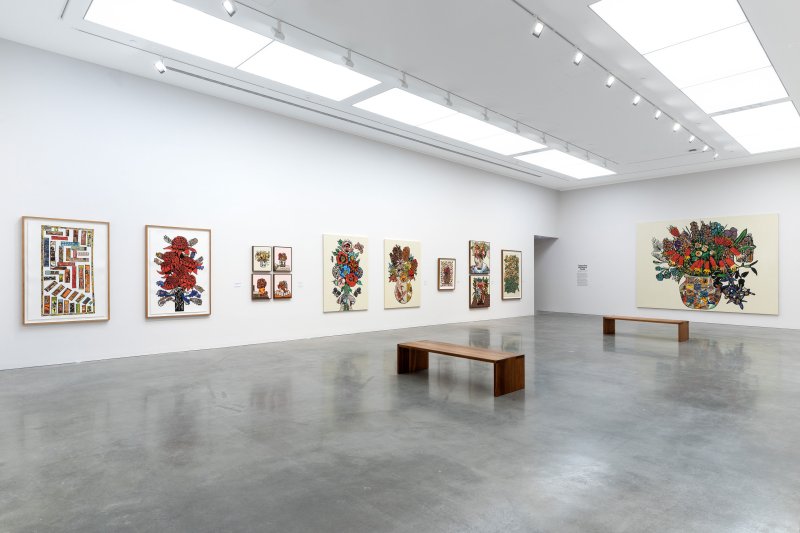
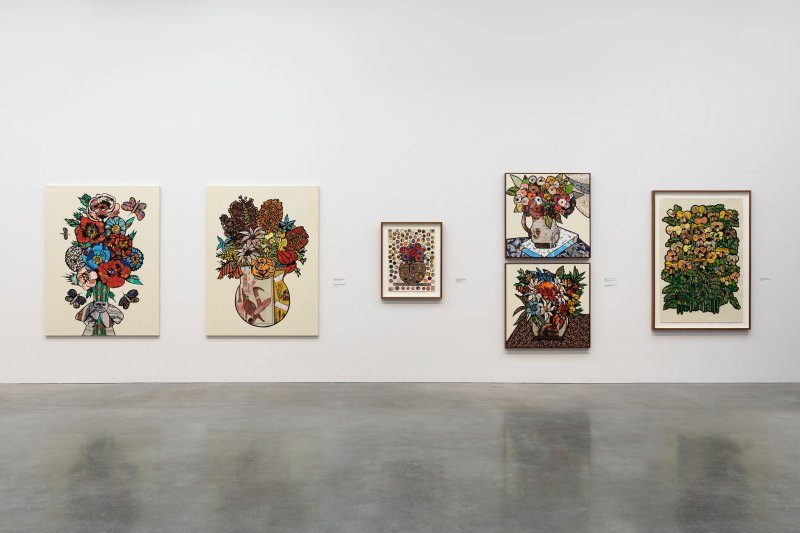
TA: I genuinely believe that everything I turned inside out and upside down in Conversations with Margaret Preston, I would have done with her in the room. I think we would have gotten along really well. I have the utmost respect for her and what she did as a queer, female artist. At a time when male artists were defining an Australian national identity through landscape painting built on a tradition imported from another country, Preston believed in a national visual identity that came from First Nations people and iconography attached to who we are as people. Women artists were doing much more and much better in that space than men were. I know many people have critical perspectives on Preston, and her slippages and misuses of Aboriginal visual culture deserve to be criticised, but let’s be honest, we are at a sophisticated point in time when we can now talk about this. She was also travelling to communities but I don’t think there would have been opportunities for conversations between Aboriginal people and white artists; even today it’s common to have a fairly disjointed conversation in English. I’m certain that Preston wasn’t having a yarn with someone about Aboriginal art down at the billabong, you know?
I worked on a Preston exhibition at the Queensland Art Gallery where her interest in Aboriginalism was completely omitted. That’s gammin. You don’t erase history; we know what that's like. Appropriating Aboriginal art, culture and identity is part of her story, and it's an important story, because we can see what has come from her influence on Australian culture. There is an amazing scene in the movie The Devil Wears Prada (2006) about Cerulean Blue where Miranda explains how high culture influences high street fashion. Margaret Preston influenced an Australian vernacular of interior design, with curtains, cushions and décor coming from Aboriginal people to the inside of suburban Australian homes. Preston advocated for chic interior design, based on an Aboriginal visual language that filtered down into cultural pillaging. This sort of pillaging doesn’t start at the bottom, and I’m not saying she is the sole catalyst, but she is a big part of that story.
LS: So, what art would you and Margaret make together?
TA: When I finished my Conversations with Margaret Preston series, I vowed to never cut another piece of fabric in my life. Margaret could be my fabric cutter, and I’d like to make monoprints together too. Imagine what she would be doing now! Margaret would be leading the way as part of the Dykes on Bikes at Mardi Gras, maybe even opening my exhibitions.
LS: I'm excited about your new book and upcoming exhibition, both titled Not a Souvenir. The publication includes 1000 works made over twenty years.
TA: The book project and the exhibition at the Museum of Contemporary Art (MCA) ran parallel and came about at a time when I was not making as much artwork because I was working with Fondation Cartier and for After the Rain.
I'm not an artist who often considers site-specificity as a framework for what I create; I work out of my studio, and once a work leaves the studio, I'm at peace with whatever happens to it. But the title of the book and the show Not a Souvenir came into fruition through the specific context of Circular Quay and the Rocks, which is the epicenter of souvenir culture in Australia. I’ve been working closely with guest curator Bruce Johnson McLean on the exhibition and Rebecca Ray, who is the Curator of First Nations Art at the MCA. Rebecca is curating an Aboriginalia room and we’re doing a national call out for people to donate or gift their Aboriginalia. The exhibition represents the largest number of works ever on loan to the MCA because one of my works may include 450 components within it. The MCA called me to say they’ve had to buy more cloud storage in order to document and register every single object; they’re literally doing a condition report on each component of every artwork. I thought it was so funny that now I'm taking up space that doesn't even exist.
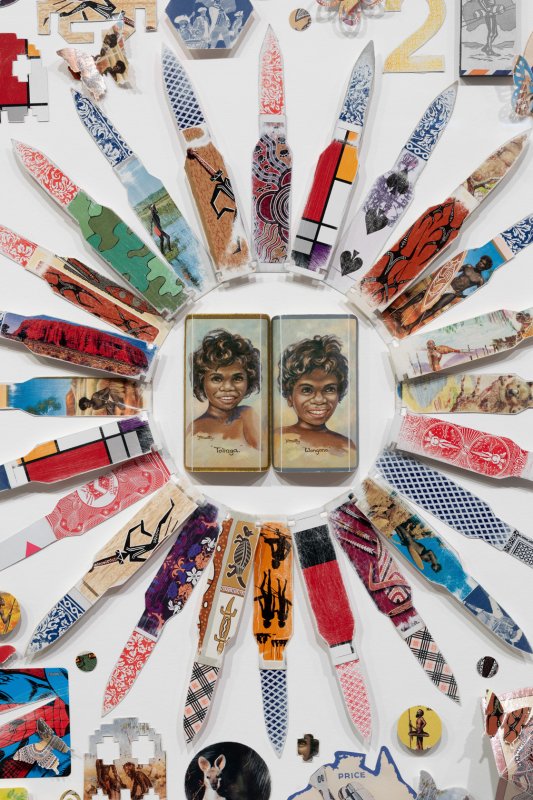
I will be there for the installation, and I like to break something during install because then everyone relaxes. You get inside these institutions, and the white gloves come out, but I always have a spare ashtray. I’ve never felt more comfortable with an exhibition, and I feel that the MCA has really looked after me throughout the whole process. Relinquishing control is important. Having gone from After the Rain where I was at the helm of decision making, I have enjoyed going back to being an artist. I see how consuming it can be to want to control everything, so I tell artists to let it go: if they spell your name wrong, it doesn’t matter; if they put a work upside down, don’t worry, it’s all good; don’t worry about things you can’t control, and focus on enjoying the experience.
1. 'Curators and Australian art history: a personal view', Andrew Sayers, Journal of Art Historiography, Number 4 June 2011. https://arthistoriography.wordpress.com/wp-content/uploads/2011/05/sayers-3.pdf
2. For more information on Michael Kempson’s print studio, see Tahjee Moar, ‘Cicada Press and the Annual Indigenous Print Workshop: Creating a New Movement’, 14 April 2016, Cicada Press, https://cicadapress.wordpress.com/2016/04/14/cicada-press-and-the-annual-indigenous-print-workshop-creating-a-new-movement/, and Anthony Springford, ‘Michael Kempson’, 27 July 2014, Cicada Press, https://cicadapress.wordpress.com/2014/07/27/michael-kempson/, both accessed 2 October 2026.
3. Contemporary Australia: Optimism, Queensland Art Gallery, 15 November 2008 – 22 February 2009. Lisa Adams, Vernon Ah Kee, Tom Alberts, Tony Albert, Del Kathryn Barton, Chris Bennie, Daniel Boyd, Matthew Bradley, Stephen Bush, Sean Cordeiro & Claire Healy, Aleks Danko, Christian de Vietri, Rolf de Heer, Gabrielle de Vietri, James Dodd, Emily Floyd, Juan Ford, Julie Fragar, Dale Frank, Mirdidingkingathi Juwarnda Sally Gabori, Mark Galea, Tarryn Gill and Pilar Mata Dupont, Kristin Headlam, Petrina Hicks, Timothy Horn, Jamin, Natasha Johns-Messenger, Christine Dew, Dave Jones & Students of Macleay Island State School, Kayili Artists (Nola Campbell, Pulpurru Davies, Mary Gibson, Jackie Kurltjunyintja Giles, Ngipi Ward), Clara Law, Sam Leach, Michael Leunig, m3architecture, Robert MacPherson, Michael McWilliams, Tim Maguire, Thomas Meadowcroft, Tom Moore, Arlo Mountford, Kate Murphy, Jan Nelson, George Nona, Raquel Ormella, Robert Owen, Debra Phillips, Patricia Piccinini, Anna Platten, Scott Redford, Victoria Reichelt, Tony Schwensen, Ritchey Sealy (NSW), Ivan Sen, Gemma Smith, Darren Sylvester, Regan Tamanui, Kathy Temin, TextaQueen, Jane Turner, Nawarupu Wunungmurra, Michael Zavros.
4. Commissioned artists included Mangala Bai Maravi, Doreen Chapman, Megan Cope, Cristina Flores Pescorán, Gail Mabo, Freddy Mamani, Dylan Mooney, Orquídeas Barrileteras, John Pule, Eric-Paul Riege, Darrell Sibosado, Kaylene Whiskey, Yangamini, and Nikau Hindin.
5. John Keane, Dot Circle & Frame: The Making of Papunya Tula Art, Upswell, Perth, 2023.
Author/s: Tony Albert & Lisa Slade
Tony Albert & Lisa Slade. 2026. “Follow The Artist Into Art History: A Conversation Between Tony Albert And Lisa Slade.” Art and Australia 61, no.2 https://artandaustralia.com/61_2/p519/follow-the-artist-into-art-history-a-conversation-between-tony-albert-and-lisa-slade
Art + Australia Art + Australia ISSN 1837-2422 All content published after October 2023 by Art + Australia is available under a Attribution-NonCommercial-NoDerivs 4.0 International Licence (CC BY-NC-ND 4.0) except where otherwise stated. For more information about use and distribution you can view our Editorial Guidelines. Art + Australia is a University of Melbourne research project
Publisher: Victorian College of the Arts
University of Melbourne


