How do art objects move in the world? What can this say about the places that they inhabit and the people who interact with them? Much of my thinking is preoccupied with this question. When employing a cultural paradigm to analyse works of art, much can be drawn from the movement of people, ideas and objects.1 As the four objects that I will discuss attest, culture moves, changes, and transforms; culture is interpreted and appropriated but it rarely stays within neat national boundaries. Approaching the history of these objects through a cultural paradigm opens new possibilities to analyse worlds that connect and interlock beyond national categories like Australia.
Undersea
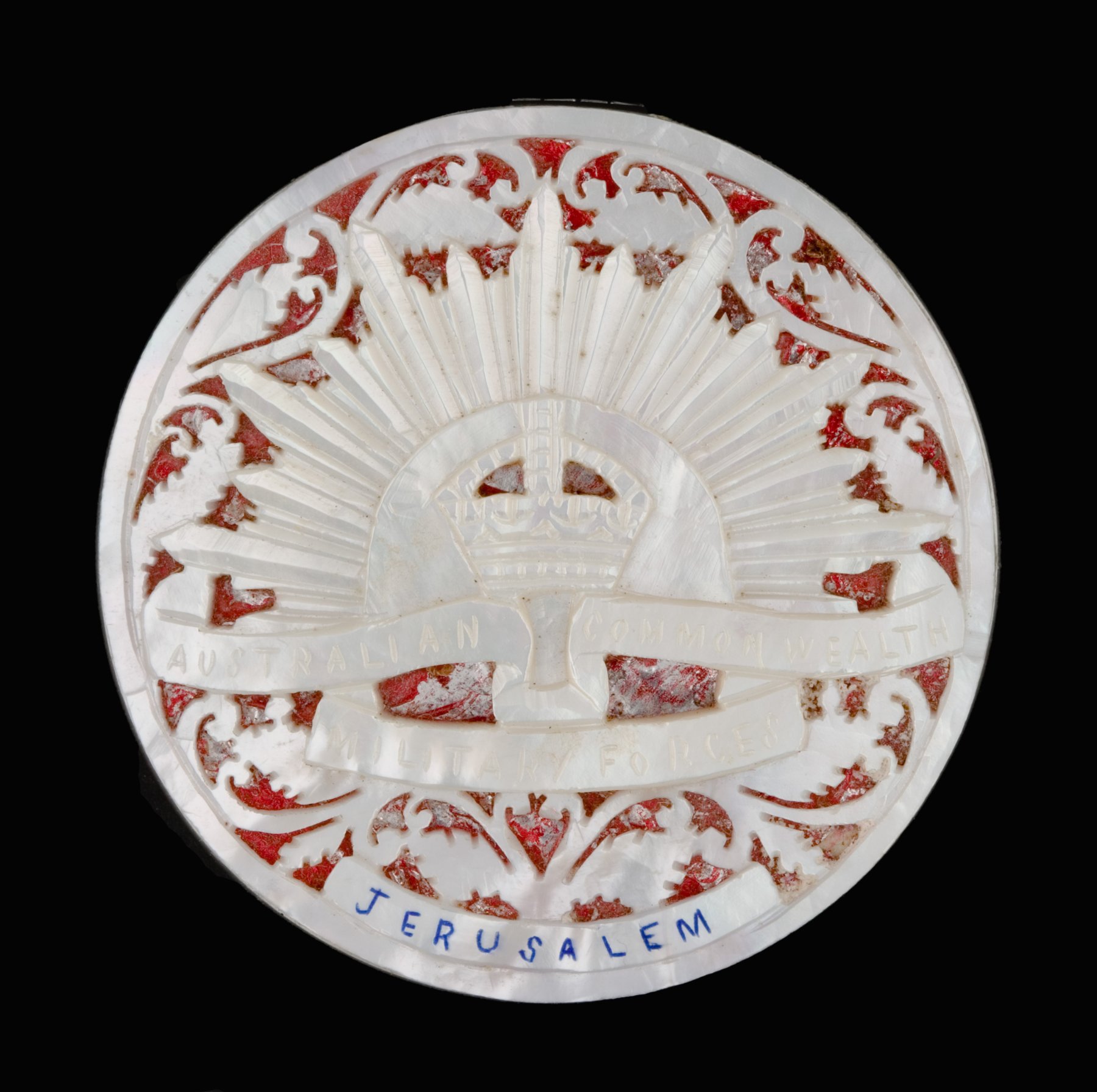
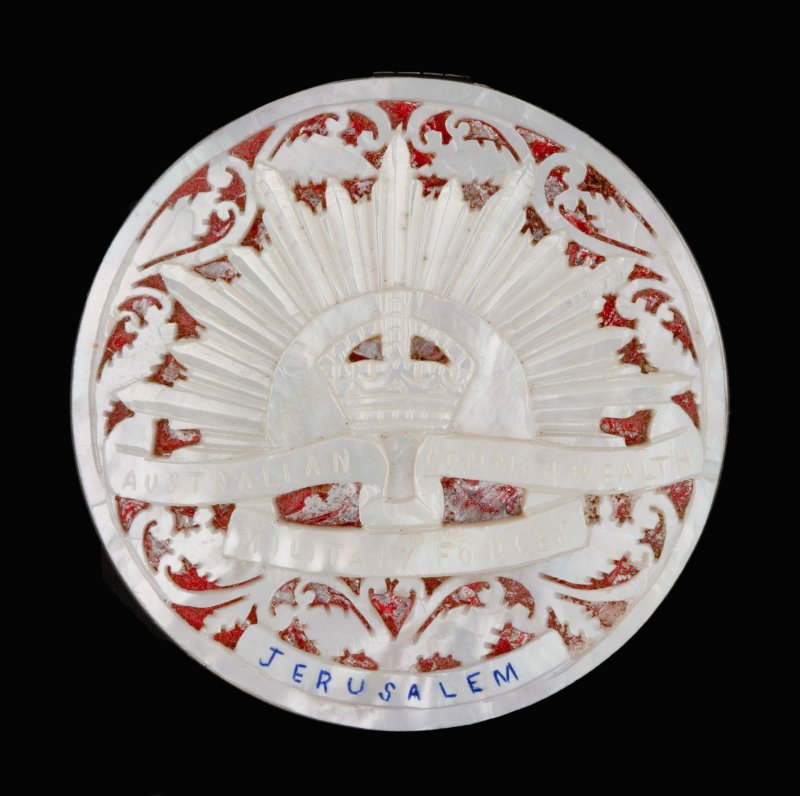
In 1941, Private James Squire Halliday Menerey, while stationed in Palestine with the 2/15th Australian Infantry Battalion, purchased a small powder compact as a present to send to his neighbour, Betty Sutherst, in Brisbane. The compact features an intricate Bethlehem-style mother of pearl carving of the Rising Sun, an emblem of a recently federated Australia and its actions in the world. The Rising Sun is finely wrought and surrounded by scrolls of vegetal motifs typical of Palestinian mother of pearl carving. Beneath it is a small banner that simply says Jerusalem. This beautiful object is now conserved at the Australian War Memorial in Canberra, but what can the appearance of Australian iconography in a Palestinian object tell us of these cultural mobilities?
Some clues can be found in the industry that produced it as well as the object itself. By the 1940s, the export industry of mother of pearl carving in Palestine was centuries old, and its trade empire radiated from the industry’s hub in Bethlehem to the far reaches of the globe. It was a major source of revenue for the city. The industry’s artisans and merchants created networks that bought raw shells from across the Caribbean, the Indian Ocean and the Pacific archipelagos, including what we now call northern Australia. In turn, carved objects were exported back to those places as well as Paris, New York, Kyiv, Port-au-Prince and elsewhere. In fact, Bethlehem’s merchants participated in many of the prestigious world fairs, including Paris (1867), London (1871), Lyon (1872), Vienna (1873), Rome (1874) and Philadelphia (1876).2 The powder compact on which the Rising Sun carving is mounted was made in the US.
Betty Sutherst’s present, as much as it represents an iconic Australian symbol, is in fact an object produced by Palestinian craftspeople from imported shell and an American cosmetics product. Indeed, it’s an object that was designed to reflect the Australian gaze, made in a visual language familiar to people like Private Menerey, a souvenir to purchase and send home. By the turn of the twentieth century, Palestinian mother of pearl merchants had created new points of operation in both Manila and Singapore where they purchased raw shells locally, including northern Australia.3 This trade was facilitated by Lebanese intermediaries who travelled from southeast Asia to Australia via Thursday Island and similarly sold Bethlehem-carved goods such as rosaries and crosses in Australia.4
While the compact has now found a home at the Australian War Memorial as a footnote in Australia’s military history, it is also an example of a centuries old Palestinian craft. It’s an object that distils a plethora of global connections, both materially and visually through a commercial speculation addressing a multitude of highly specific consumer demographics. The humble, ornate, decorative exterior of this object veils the highly modern connectivity that enabled its making. It demonstrates layers of cultural appropriations that complicate straightforward readings of ownership as either a Palestinian or an Australian object, cutting across cartographies of relations.
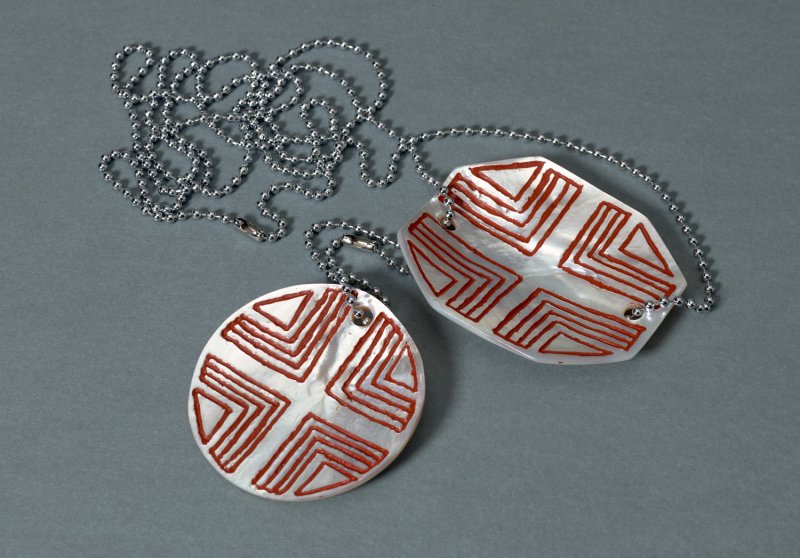
This movement of people, objects and ideas can be seen in other contexts involving mother of pearl. Bardi man, Ron Bradfield’s Well done, that Aamba! (2024), while contemporary, provides an interesting point of comparison. Bradfield’s work fuses together the ancient cultural practice of riji production from guwan (shells) with military dog tags. Bradfield spent a decade serving in the Australian armed forces. After leaving the army, Bradfield noticed he was no longer afforded the protection from racism his uniform granted.5
Speaking to Bradfield about the work, he talks about the history of producing rijis. He tells me how they were made as part of men’s business. He also tells me of the histories of trade in guwan. Guwan were traded northwards with the Makassans—a fact of which I had been previously aware—but also southwards across the continent to places we now call Adelaide or Victoria through extensive inland trade networks. These precious objects associated with water and life were taken and traded, arriving in places that were far from the oceans where they originated.6
Well done, that Aamba! mimics the military ‘dog tag’—more accurately a military identification tag—an object worn by soldiers and used to identify casualties of war. The word Aamba is Bardi for man, an affirmation that must be read in the racism felt by Aboriginal servicemen. Here, Bradfield centres a Bardi cultural lens to reimagine the ‘death business’ of the dog tag through the ‘life business of the riji’. It is an act of reclaiming his identity.
Reading Well done, that Aamba! in relation to the powder compact, we see two examples of works that hint at the diversity of visual cultures that arise from the mobility of servicemen and the process of meaning-making involved with mother of pearl production. While the global materiality of the well-travelled powder compact meets the gaze of the new Australian nation, Bradfield’s work is a project of Indigenous world-making that rises up from within that same nation to assert its place through a very different vision of this continent.
Overland
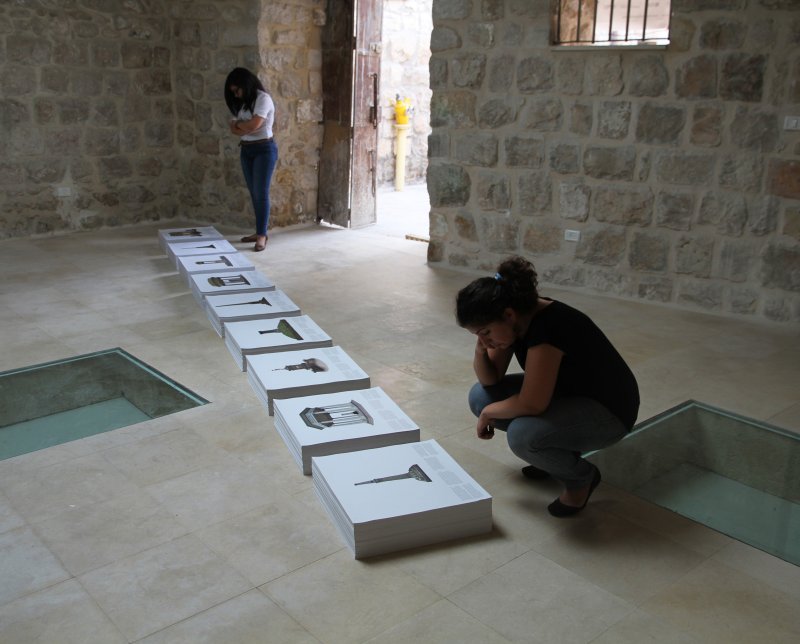
Where the compact and Bradfield’s dog tags speak to how objects are materially constituted through trans-national paradigms, Tom Nicholson’s Comparative Monument (Palestine) mines the past to demonstrate how cultural paradigms change. His work takes visualisations from Australian war memorials that bear the name Palestine with a proposition that the physical memorials be moved to line the main street of Beer Sheba. The artwork, as it is presented, comprises nine posters, each with the photograph of an Australian war memorial, reproduced and stacked in meticulous piles that viewers are invited to take. The form of the poster—with its historical associations around the dissemination of information—acts here as mode of historical recovery. In this work, Nicholson documented Australian war memorials in Victoria and in so doing engendered an official recognition of Palestine from the first half of the twentieth century, making the Australian government’s 2025 recognition of the State of Palestine in the context of the current war a return rather than a beginning. Nicholson prompts a repatriation of sorts by questioning the ever-changing historical memory of the Australian state. Cutting across time and the contestation, construction or elimination of nation-states, an act of solidarity takes place in Comparative monument (Palestine), questioning how the nation-state remembers and what this memory holds for the future.
Another poster similarly questions the nation-state’s identity, hinting at its porous nature. Little is known about the maker of this poster or the context in which it was produced. However, it came from the archive of the late Ali Kazak (1948-2025), a Palestinian activist and diplomat. Kazak founded the Palestinian diplomatic mission in Australia in 1982, what has since become the Palestinian Embassy in Australia, the organ of official mutual recognition of one state with another. He was also a longstanding friend of Gumbaynggirr activist and historian Professor Gary Foley. Meticulous in keeping his archives, Kazak had collected several copies of this poster alongside a handful of other Aboriginal posters in a much larger collection that is primarily focussed on Palestine.
The poster, likely from the late 1970s or 1980s, compares Aboriginal experiences with those of the Sioux, Palestinians, Zimbabweans and East Timorese, charting a global cartography of colonialism and solidarity. Each of the peoples were enmeshed with decolonial struggles for independence against various colonial regimes, some continuing to this day. The text on the poster effectively draws a delineation between the nation-state as a political formation and those others who are governed by it.
However, the poster never mentions the words Black, Indigenous or Aboriginal, instead choosing the terminology dispossessed Australians. With the authorship of the poster unknown, it is difficult to fully ascertain the intentions of such descriptors. Nonetheless, in using the moniker Australian in this context, a sublimation of Indigenous identity takes place.
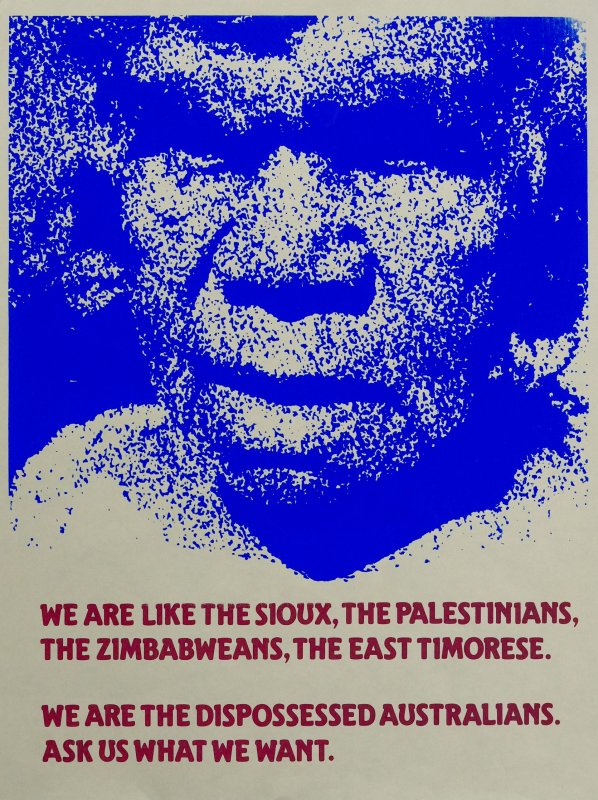
The language of the poster reflects the debates taking place in the 1970s between the rhetoric of inclusion versus a rising Black nationalism.7 This prompts a question: was its making a radical act that sought to confer an Australian identity on Indigenous peoples, or to sublimate Indigenous identity in service of the Australian national body? Without knowledge of the poster’s maker or makers, it is impossible to know; however, by situating it in its cultural context, we can better understand the competing claims to history it contains.
As diverse as these four works are, each connect to what we might consider Australian-ness. Their production, mobility and reception push and pull at the constitution of a singular national cultural paradigm thereby unsettling the opacity of these political structures. The powder compact shows the meeting of trans-local cultural producers and consumers, while Well done, that Aamba! pierces the veneer of the state from within. Untitled Monument (Palestine) operates in a similar way, excavating the recognition of Palestine in Australia’s past to enact solidarity in the present. In turn, the poster from the Kazak collection questions the trajectory of Indigenous political activism and its relationship to the Australian state. Each demonstrate how works of art yield cultural histories that undermine the totalising lens of any given national culture. Instead, they reflect a plurality of perspectives that travel beyond borders, showing us that we share a social world of mutual influence and interconnectivity.
1. Liat Kozma, Cyrus Schayegh and Avner Wishnitzer (eds), A Global Middle East: Mobility, Materiality and Culture in the Modern Age, 1880–1940 , I.B. Tauris, London, 2015, p. 6.
2. See Jacob Norris, The Lives and Deaths of Jubrail Dabdoub: Or, How the Bethlehemites Discovered Amerka, Stanford University Press, Stanford, 2023, p. 73; Linda K. Jacobs ‘Palestine at the Centennial Fair of 1876’, Jerusalem Quarterly, no. 80, Winter 2019, pp. 76-91. KH note: exact page(s) needed here. If not needed, please insert the article’s full page range pp. 76-91.
3. Jacob Norris, ‘Exporting the Holy Land: Artisans and Merchant Migrants in Ottoman-Era Bethlehem’, Mashriq and Mahjar: Journal of Middle East and North African Migration Studies, vol. 1, no. 2, 2013, p. 33.
4. Norris, ‘Exporting the Holy Land’, p. 35.
5. This was also the subject of another of Bradfield’s works In Plain Sight (2020) in the Australian War Memorial’s collection, https://www.awm.gov.au/collection/C2732404
6. Author’s conversation with Ron Bradfield, 3 June 2026.
7. Russell McGregor 'Another Nation: Aboriginal Activism in the Late 1960s and Early 1970s', Australian Historical Studies, 40 (3), p. 343.
Art + Australia Art + Australia ISSN 1837-2422 All content published after October 2023 by Art + Australia is available under a Attribution-NonCommercial-NoDerivs 4.0 International Licence (CC BY-NC-ND 4.0) except where otherwise stated. For more information about use and distribution you can view our Editorial Guidelines. Art + Australia is a University of Melbourne research project
Publisher: Victorian College of the Arts
University of Melbourne


