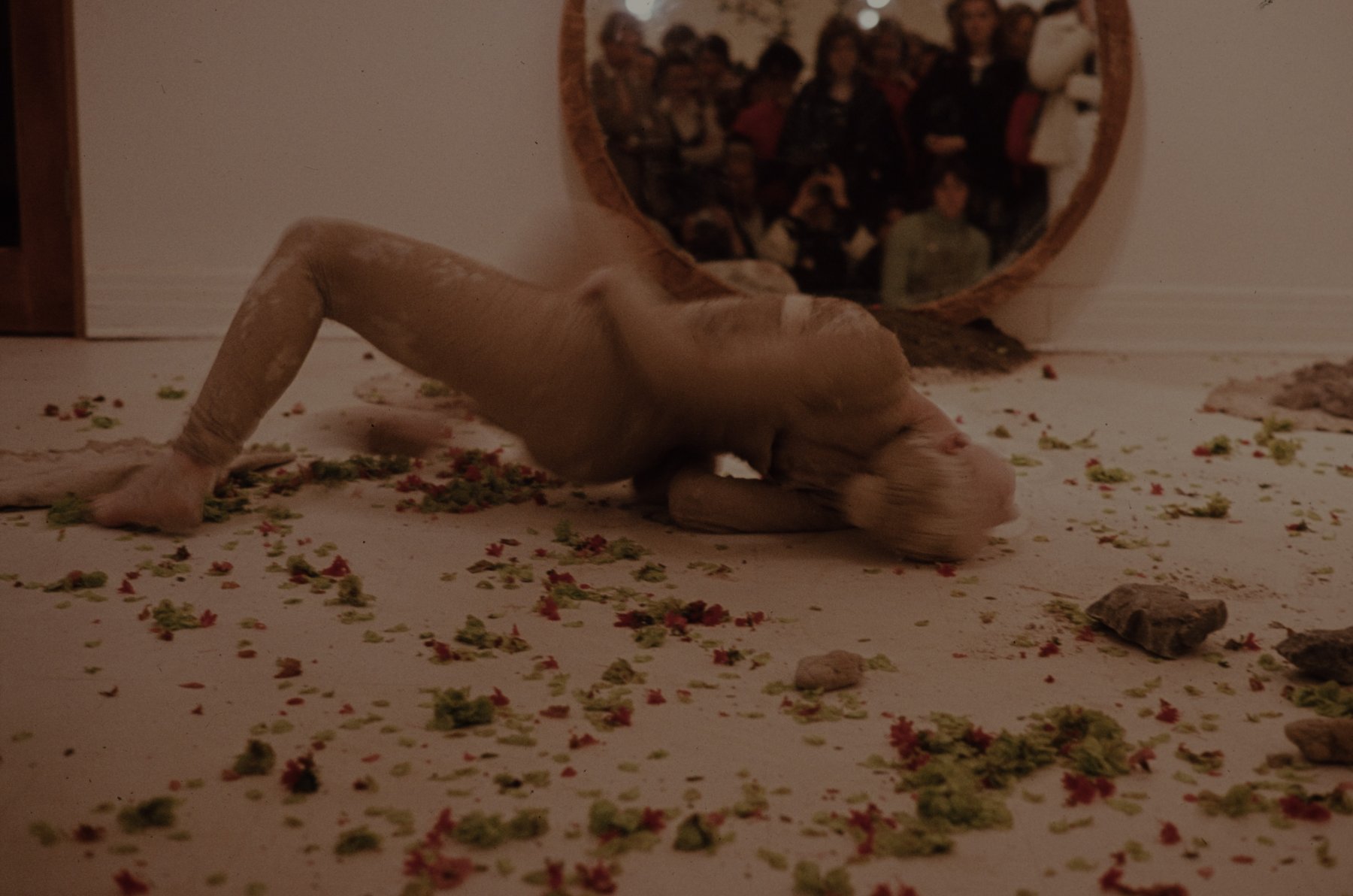
The George Paton Gallery (GPG) is constituted by its place within the Student Union—an organisation that has funded, provided infrastructure and proximity to the University of Melbourne’s student culture. The Union’s support has been essential to creating the conditions for the Gallery to platform experimental art since Kiffy Rubbo’s appointment as Director in 1971. The Gallery exercised considerable curatorial latitude within the Union, but remained dependent on an institutional structure whose financial and administrative conditions it did not control. This model has supported the Gallery, while exposing it to changing institutional definitions of ‘student value’—particularly within the first two decades of the Gallery’s existence. Where existing histories have foregrounded the Gallery’s influential directors and artistic programs, this article shifts the scope of existing interpretations to examine the institutional conditions within the Student Union that have shaped the GPG.
Anything Goes
The Gallery has never possessed a singular curatorial logic. To understand how it acquired its experimental latitude, it is necessary first to examine the institutional arrangement that made this possible. By and large, the Gallery was financed through Union fees paid by students to the University as part of the Amenities and Services (A&S) fee. Recurrent funding was also provided by the Victorian Arts Board (VAB), but the Gallery’s principal financial support came through the Union.1 Union House itself operated under a peppercorn tenancy agreement with the University, substantively meaning the Union paid a token amount to lease the building.2 The Gallery’s location within Union House, a crossroads for student life, placed artists and directors in close proximity to students and their political activities and dreams of revolution. This physical and institutional setting was a formative condition for the Gallery’s early directors to develop their programs.3 The Union exercised considerable institutional autonomy within the limits of University Council authority. Within the Gallery, the absence of a management board concentrated programmatic authority in the director. The Gallery’s remit encompassed exhibitions and public programming with student and graduate artists of the University, and unaffiliated national and international artists—in other words, the parameters of the Gallery’s program materialised largely through the priorities of its directors. This ‘anything goes’ approach to the Gallery’s program was sustained in its early years, even as individual directors interpreted and used that freedom to different ends.
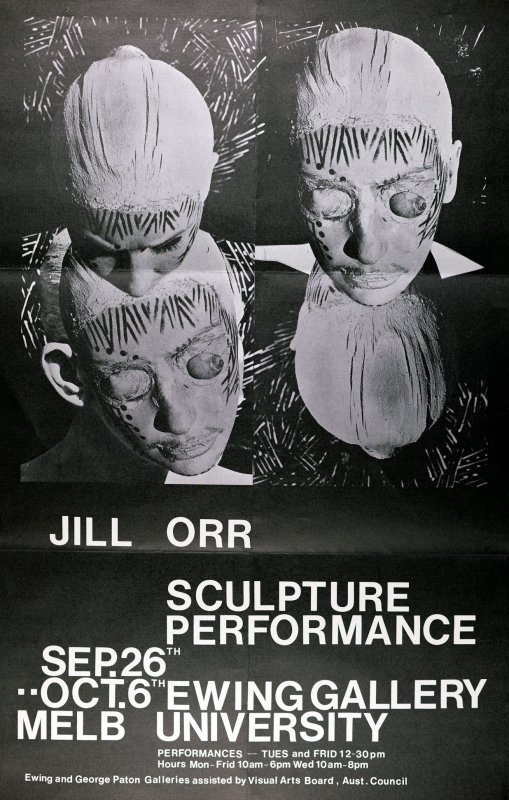
While the Gallery’s definition of ‘experimental practice’ would shift across directorships, its formative terms were established by Kiffy Rubbo and Meredith Rogers. Rubbo was appointed Director of the Rowden White Library in 1971 and soon thereafter the Ewing Gallery.4 With additional funding from the Australia Council, she expanded the original single gallery in 1974 and appointed Rogers as Assistant Director.5 The following year, the two spaces jointly operated as the Ewing and George Paton Gallery (EGPG). Rubbo and Rogers described their partnership as a 'song and dance act'—a collaborative and complementary experimental creativity.6
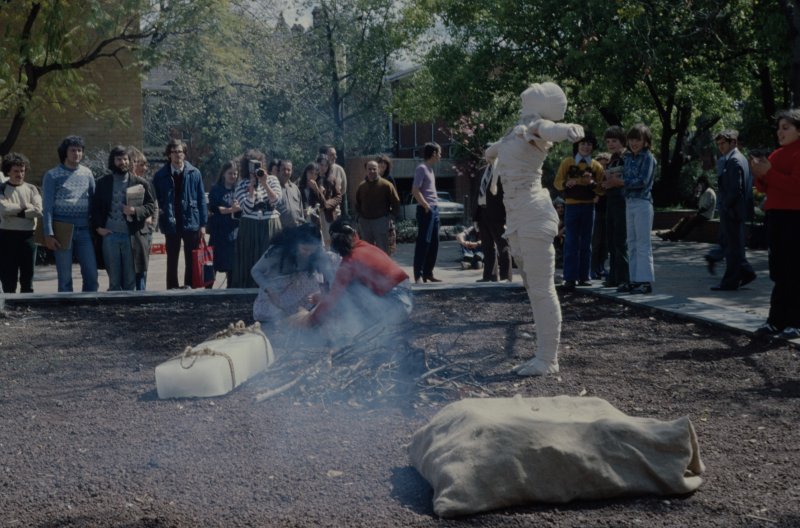
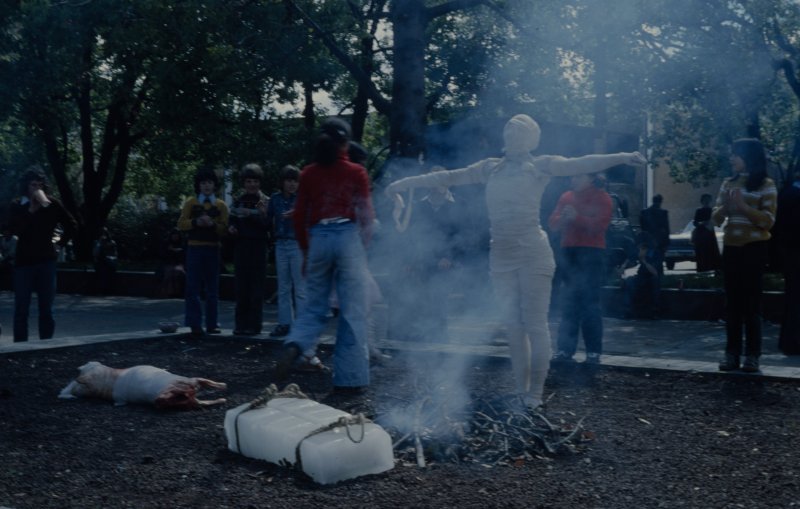
Rubbo was spontaneous where Rogers was considered; both were sparkly, extroverted, and motivated to connect with their community.7 They saw a need to platform art not seen elsewhere and ‘to break down the barriers which surround art.’8 The radical art that Rubbo and Rogers programmed was oftentimes durational, politically engaged and collectivist in nature. Jill Orr’s 1978 performance Inside Jack’s Head demonstrates the spirit of these conditions and the possibilities they created. Staged during her multimedia exhibition Sculpture Performance at the Ewing Gallery, the event is documented through a combination of photographic documentation and the artist's own written account. On the North Court of Union House, Orr emerged entirely bandaged before a sheep carcass, fire and ice block, while a group of primary school students circled the platform chanting nursery rhymes.9 A driver herded the children into the back of a van to drive them back to school as Orr unravelled her bandages and led the assembled audience to the Gallery for a second performance.10 The final still from Inside Jack’s Head, viewed from behind three children as spectators occupy the balconies and chairs of Union House, captures this era of participatory, confrontational art, permeating beyond the Gallery onto the campus. As Orr retrospectively recounted, ‘In the 1970s, we could do anything.’11
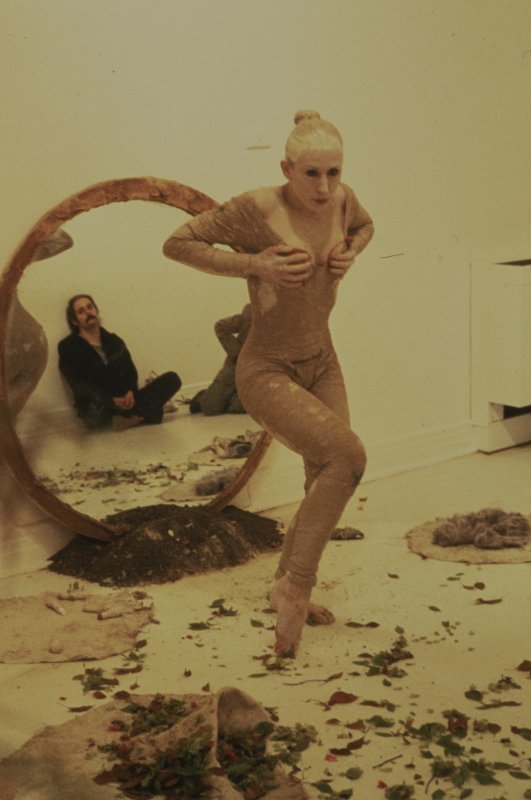
When Rubbo died unexpectedly in November 1980, Judy Annear had already begun shifting the Gallery’s curatorial direction.12 Rubbo’s death was a profound rupture in the GPG’s programming, but the Union continued to exercise relatively light oversight over the Gallery’s program, leaving substantial authority with its director. Annear’s appointment as Assistant Director and subsequently as Director demonstrated that the Gallery could persist even as its leadership changed, and reflected a substantially different understanding of what an ‘alternative space’ could do.13 Women at Work: A Week of Women’s Performance, a five-day program in June 1980,14 was proposed by Anne Marsh and Jane Kent to Rubbo and Annear in 1979 and realised under Annear’s directorship.15 The program marks a transition in the Gallery’s curatorial direction, as feminist politics became increasingly entangled with the theoretical and critical concerns Annear brought to its programming.
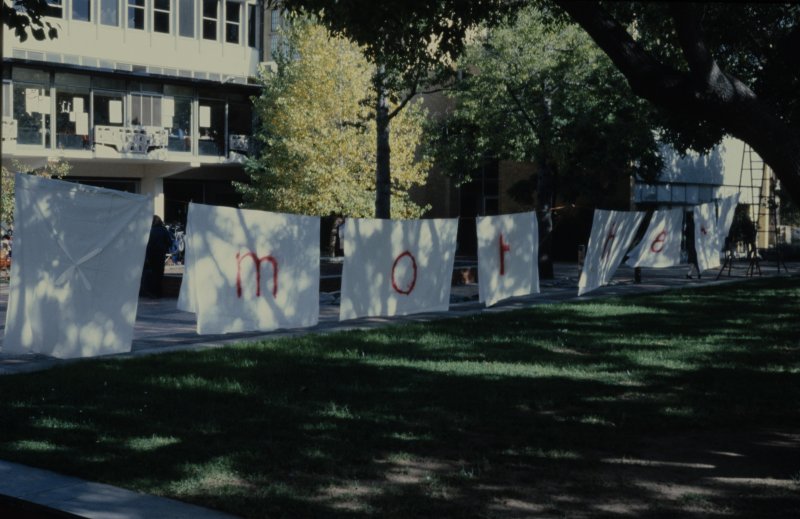
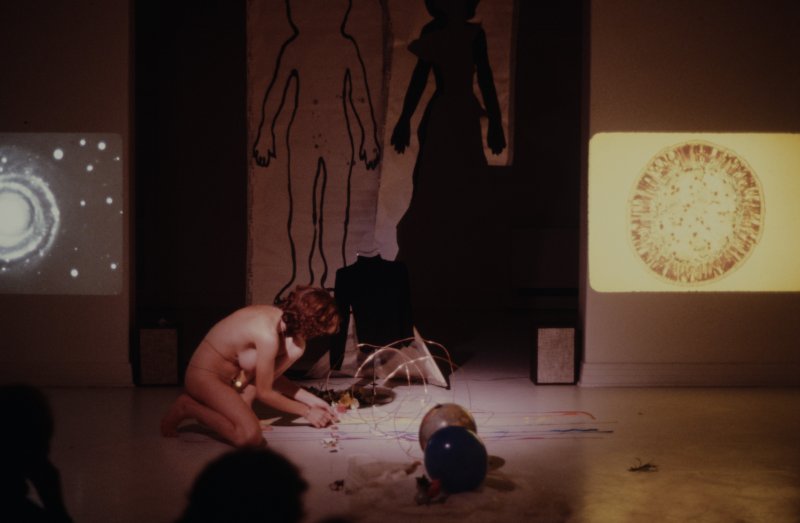
Structured to challenge its audience through performance, discussion and debate, Annear and her Assistant Director, Aleks Danko, deliberately assembled a wide range of approaches, from what they described as the ‘very public’ performances of Bonita Ely, Ann Fogarty and Anne Marsh to the ‘very private’ work of Catherine Cherry.16 The event brought together twelve women artists from across Australia for fourteen performances extending across the Gallery, Union House and beyond the University campus. In Bonita Ely’s Murray River Punch, the artist adopted the persona of a cooking-show hostess in the Union House foyer, preparing a noxious “punch” from sewage and chemicals as a commentary on the pollution of the Murray River following European settlement along its banks. Ann Fogarty’s Mother, staged on Union Lawn, transformed domestic washing into public performance by stringing sheets across the lawn bearing words including “everyday,” “nurse,” “mother,” “wash,” “cook” and “clean”—bringing feminised domestic labour to the University’s public. Catherine Cherry, in her three integrated performances—Pulling out the Stops, Theory of Relativity and Quantum Mechanics—paired bodily and intuitive experience with scientific knowledges.17 Through the gendered language of pudendum muliebre—‘that of a woman which should be ashamed’—and principles of physics, Cherry unsettled the boundaries of experience.18
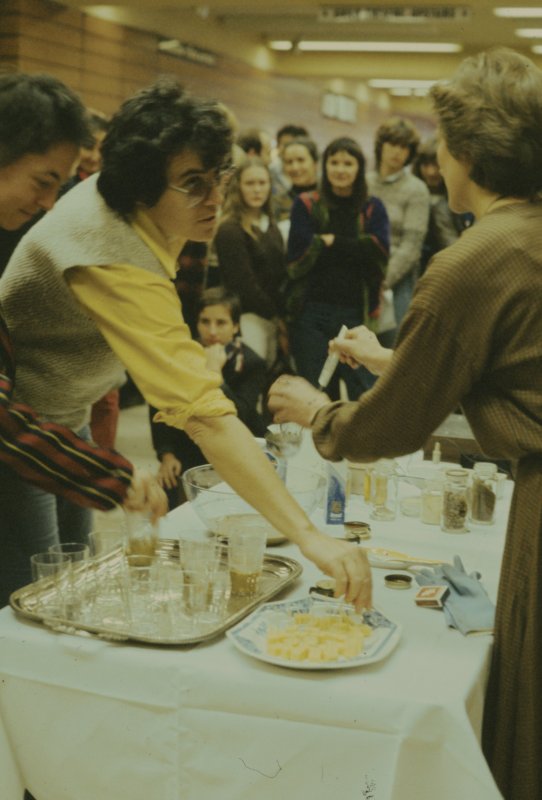
Danko’s photographs form part of this visual record, while Annear facilitated the forums where participating artists reflected on the week’s proceedings and their personal relationship between practice and feminist theory. Annear and Danko later transcribed these discussions into the event catalogue, extending the program’s record beyond the ephemerality of the performances themselves.19 These dialogues reveal that performance, along with its audiences and documentation, were contested. Performance, intended to take art beyond the gallery, was, some artists argued, finding its way back inside. Others questioned whether documentation could preserve the immediacy of performance or if its value resided in those it reached. These debates capture the shifting terms of experimental practice under Annear: the Gallery remained a space in which the boundaries of art could be challenged, even as the meaning of an ‘alternative space’ continued to change.
Rearranging deckchairs on the Titanic
The will to sustain the GPG as a politically engaged and experimental art space persisted, but the institutional conditions that had enabled that role became increasingly difficult to maintain. Financial accountability, institutional control, student democracy and competing definitions of cultural value converged around the question of what terms could justify the Gallery’s continued place within the Union.
That change became materially apparent in 1979 when the Union’s Statement of Income and Expenditure recorded a loss of $191,888 within the Catering Department.20 The shortfall continued, and by March 1981, the Student Union magazine Farrago reported that the Union’s catering losses were projected to balloon to over $317,000, significantly exceeding the Board’s estimates.21 Union Administrator Ron Field attributed this compounding crisis to a failure to keep pace with wage increases.22 While standard Union staff wage growth had been factored into the budget, a sudden 4% increase in University administration costs had not, leaving the Union to absorb the additional charge within its existing budget.23 Field attributed his predicament to the inherent constraint of a funding structure mediated by the University. Under this arrangement, the University collected the A&S fee and distributed it among campus services and organisations, with 60 per cent allocated to the Union.24 When additional costs arose, Field had little capacity to increase the Union’s income, reducing his apparent options to a single realistic course: absorbing the costs within the allocation already received. As he put it, ‘What I’m supposed to do is find the money for the 4 per cent within the budget—it’s Hobson’s choice.’25 Field’s Hobson’s choice exposed the broader institutional hierarchy which authorised the University Council’s discretion over Union affairs.26 As financial pressures mounted, disputes over the limits of that authority sharpened, culminating in the conflicts of 1985–86.27
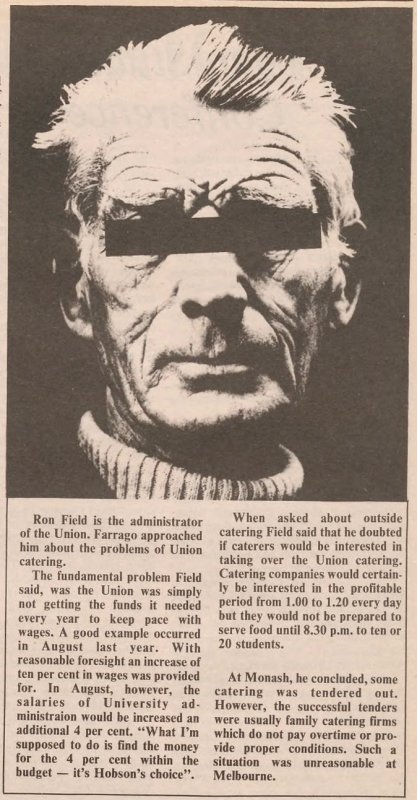
Confronted by the compounding catering deficit, the Union Board voted in October 1985 to cease funding the Gallery, subject to the student referendum the following April 1986.28 Writing in Farrago, former Board members present themselves as willing to submit the decision to the student body, while accusing Gallery supporters of ‘{putting} aside ideas of democracy and student control’ by circumventing the electoral process and lobbying University administration to intervene—the touchstone for the Vice-Chancellor’s motion to sack the Board in December 1985 and initiate an inquiry into Union management.29 Inversely, the GPG’s archival history, published by Helen Vivian, Susan Hewitt and Sandie Bridie, reconstructs the episode differently.30 It dates the Board’s vote to September 1985 and situates the closure attempt within concerted efforts to force out GPG Director Denise Robinson.31 In this telling, the Board’s professed patience for a democratic verdict was rather less voluntary, its closure decision having been checked by existing staff contracts. In this account, the Vice-Chancellor’s intervention and subsequent reversal of closure are therefore less an act of political solidarity than the enforcement of the University’s legal obligations, granting the Gallery a temporary reprieve until August 1986.32
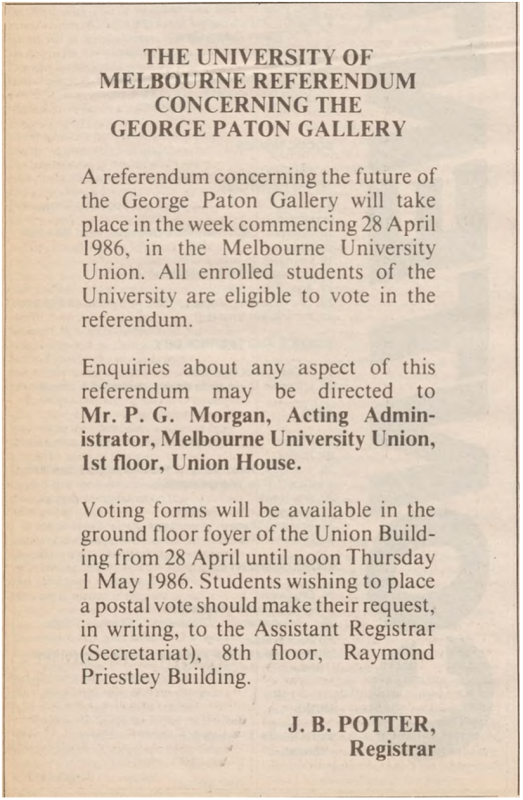
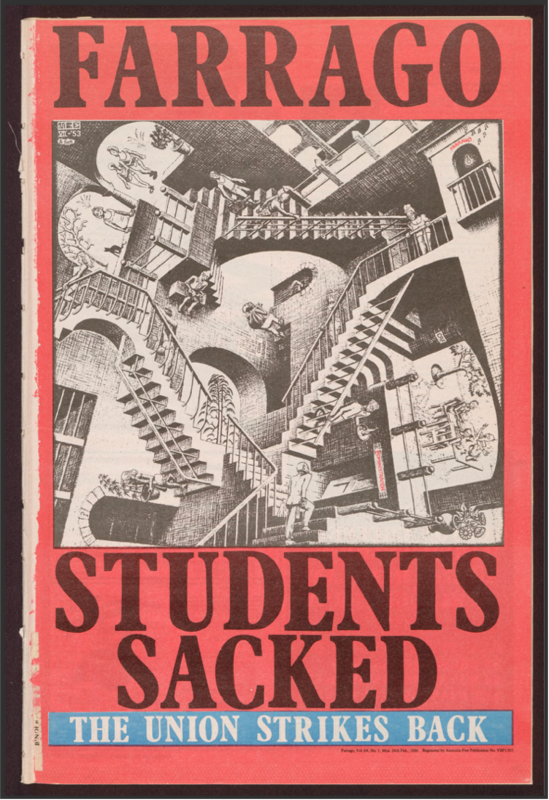
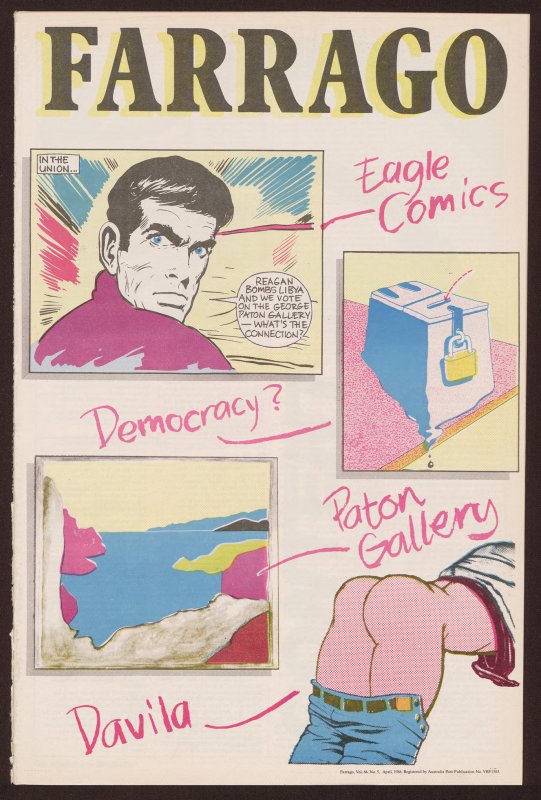
Farrago’s 1986 issue, dedicated to the commotion surrounding the GPG, captures the unresolved tensions of the Gallery’s future.33 The issue's provocative cover art montaged these anxieties as a question of student democracy and institutional power. The question of “Democracy?” placed before a tightly locked ballot box presents democratic authority as an object of dispute.
The long-awaited referenda provided conflicting verdicts: one polled majority opposed funding the Gallery from the A&S fee; the other favoured its continuation. The two referenda asked different questions and drew different voting populations, leaving the Gallery's future unresolved.34 The following year, Union Board members again scrutinised the allocation of the $250 A&S fee to the GPG, despite the Gallery accounting for only 1.2 per cent of the student levy.35 By 1990, its reputation as an important locus of creative experimentation offered no protection within an underfunded and politically divided Union. Arguments that the Gallery provided insufficient value to students were one strand of a wider dispute over expenditure, governance and cultural responsibility within the Student Union.36
At its December 1989 budget meeting, the Student Council voted 11–6 to cease the Gallery’s annual funding from the Union.37 A compromise nevertheless kept the Gallery operating through 1990, largely through government grants, drawing upon the Australia Council support first secured under Rubbo more than fifteen years earlier.38 The following year, an emergency Student Council meeting ended without a decision to sustain the Gallery, forfeiting $60,000 in prospective Australia Council funding and precipitating its closure.39 When it reopened in 1994, no longer did the curatorial direction embrace an 'anything goes' approach to art and culture on campus; it reconstituted its institutional purpose around a more explicit principle of student benefit.40
Future Pasts
The Gallery’s archive records its role as a crucible for generations of artists, curators, writers and audiences. Union House and Farrago were part of this same cultural ecology, bringing artists, writers, students and audiences into contact with one another. While the Union was arguing over the Gallery’s legitimacy in the 1980s, curators and art workers were getting on with the business of exhibitions and art making. The radicalism now associated with the Gallery’s early history was produced amid uncertainty and institutional constraint.
I reject pessimistic views that the radical political energy of previous decades cannot exist today. The Gallery’s continuation demonstrates a cultural threshold, which, in this context, means walking the tightrope between experimental freedom and institutional dependence within the University. That was their history, but it is ours too. The possibilities and limits of an ‘alternative space’ still remain unsettled. Questions of what might survive of experimental practice were already being debated in the Women at Work dialogues. Anne Marsh emphasised the importance of leaving a record for future generations of women.41 Ann Fogarty suggested that the experience and significance of a performance also endure through those it reaches.42 Documentation preserves a record for future generations, but not the experience of having been there. This article is partly a product of that tension, reconstructing ephemeral performances through what survives while acknowledging what cannot be recovered. No one Women at Work participant could anticipate how their activities would be interpreted by subsequent generations, but these critical debates remain consequential.
Today, the Gallery’s cultural value continues to be produced through participation, even as its existence depends on the institutional arrangements that recognise and sustain that value. Field’s ‘Hobson’s choice’ described an institution forced to find room within conditions it could not wholly determine. Yet the Gallery’s history cautions against treating institutional constraint as the end of possibility.
1. Kiffy Rubbo and Meredith Rogers, “Ewing Gallery.” Farrago 53, no. 1 (1975); Chris Tsiolkas, “George Paton Gallery,” Farrago Vol.66 no. 1, 1987.
2. Hitherto, Union House paid an essentially nominal and token amount to the University of Melbourne which fulfilled contractual lease agreements. As I understand it the University had a constitutional commitment to providing students with amenities, which was supported by this peppercorn lease agreement (as opposed to stinging the Union with commercial market rates). This all changed in 2023, spurred by the new student precinct. UMSU was now ‘required to pay the University almost $400,000 in property outgoings’, which as UMSU's legal council Phoebe Churches says ‘is a kind of SSAF laundering’ when the University allocates SSAF funding to the Student Union then recieves those funds back in the form of rental charges.
“UMSU’s SSAF Funding up in the Air as University Imposes Hefty Rental Charges,” published 9 October, 2022. https://umsu.unimelb.edu.au/news/article/7797/UMSUs-SSAF-Funding-up-in-the-Air-as-University-Imposes-Hefty-Rental-Charges/
3. Helen Vivian et al., “History of the Ewing and George Paton Galleries 1971-1990,” UMSU – University of Melbourne Student Union, published 2022, 1; Waghorne, By students for students, 140; Helen Vivian et al., “History of the Ewing and George Paton,” 1; Charmaine Ching, “Remembering the Ewing and George Paton Galleries,” University of Melbourne Collections, no. 14 (June 2014): 22.
4. Frances Lindsay, “Leadership and legacy,” in Kiffy Rubbo: Curating the 1970s, edited by Janine Burke and Helen Hughes (Scribe, 2016), 9.
5. Frances Lindsay, “Leadership and legacy,” 10.
6. Meredith Rogers, “Kiffy Rubbo: Some Recollections,” Lip, no. 6 (1981/2): 90.
7. Meredith Rogers, “Kiffy Rubbo,” 89–90.
8. Kiffy Rubbo and Meredith Rogers, “Ewing Gallery.” Farrago 53, no. 1 (1975)
9. Jill Orr, “Continuum,” in Kiffy Rubbo: Curating the 1970s, edited by Janine Burke and Helen Hughes (Scribe, 2016), 121.
10. Orr, “Continuum,” 122.
11. Orr, “Continuum,” 122.
12. Rogers, “Kiffy Rubbo,” 90.
13. Helen Vivian et al., “History of the Ewing and George Paton Galleries 1971-1990,” 33.
14. Judy Annear and Aleks Danko eds., Women At Work: A Week of Women's Performance, The George Paton Gallery, 1980.
15. Anne Marsh, “A Brief History of Performance Art at the George Paton Gallery,” in Kiffy Rubbo: Curating the 1970s, edited by Janine Burke and Helen Hughes (Scribe, 2016), 128.
16. Annear and Danko, eds., Women at Work, 2.
17. Annear and Danko, eds., Women at Work, 19.
18. Annear and Danko, eds., Women at Work, 19.
19. Annear and Danko, eds., Women at Work, 2.
20. “Melbourne University Union: Statement of Income and Expenditure for the Year Ended 31 December 1979,” Farrago 58, no. 13 (1980) [date: July 25th, 1980].
21. “Shit hits the fan,” Farrago 59, no. 4 (1981) - March 27, 1981.
22. “$153 of what?” Farrago 59, no. 1, 1981
23. “$153 of what?” Farrago 59, no. 1, 1981
24. Simone McGurk and Charles Richardson, “The Union Strikes Back” Farrago 64, no. 1 (1986).
25. “$153 of what?” Farrago 59, no. 1, 1981
26. The score on pinballs, Farrago 58, no. 1, 1980
27. From the perspective of the student-led Union Board, the crisis reached a tipping point in October 1985. Simone McGurk and Charles Richardson, “The Union Strikes Back” Farrago 64, No. 1 (1986).
28. Simone McGurk and Charles Richardson, “The Union Strikes Back” Farrago 64, no. 1 (1986).
29. Simone McGurk and Charles Richardson, “The Union Strikes Back” Farrago 64, No. 1 (1986).
30. Helen Vivian et al., “History of the Ewing and George Paton,” 59.
31. Helen Vivian et al., “History of the Ewing and George Paton,” 59.
32. Helen Vivian et al., “History of the Ewing and George Paton,” 59.
33. “The University of Melbourne Referendum Concerning the George Paton Gallery,” Farrago 64, no. 5, (1986)
34. Merran White & Nigel Eyre, “The Great Gallery Debate,” Farrago 64, no. 6, 1986; Andrew Watson, President’s Column “Interim Union Committee/ Referendum Results.” Farrago 64, no. 6, 1986.
35. Chris Tsiolkas, “George Paton Gallery.” Farrago Vol.66 no. 1, 1987.
36. Christopher Heathcote, “Sexism and the Gallery Issue,” Farrago 64, no. 3 (1986); Various policy speeches for the committee elections, Farrago Vol.66 no. 1, 1987.
37. Ian Pattison, "Gallery Funds Cut," Farrago 69, no. 1, 1990.
38. Ian Pattison, "Gallery Funds Cut," Farrago 69, no. 1, 1990; Kiffy Rubbo and Meredith Rogers, “Ewing Gallery.” Farrago 53, no. 1 (1975).
39. "Gallery Gone," Farrago 70, no. 1, 1991.
40. Helen Vivian et al., “History of the Ewing and George Paton,” 75; “The Proposed Changes Under the Tertiary Education (Amendment) Bill” Farrago 73, no. 6, 1994.
41. Annear and Danko, eds., Women at Work, 5.
42. Annear and Danko, eds., Women at Work, 5.
Author/s: Rosalina Coulter
Rosalina Coulter. 2026. “Hobson's Choice: Future Pasts Of The George Paton Gallery.” Art and Australia 61, no.2 https://artandaustralia.com/61_2/p492/hobson039s-choice-future-pasts-of-the-george-paton-gallery
Art + Australia Art + Australia ISSN 1837-2422 All content published after October 2023 by Art + Australia is available under a Attribution-NonCommercial-NoDerivs 4.0 International Licence (CC BY-NC-ND 4.0) except where otherwise stated. For more information about use and distribution you can view our Editorial Guidelines. Art + Australia is a University of Melbourne research project
Publisher: Victorian College of the Arts
University of Melbourne


