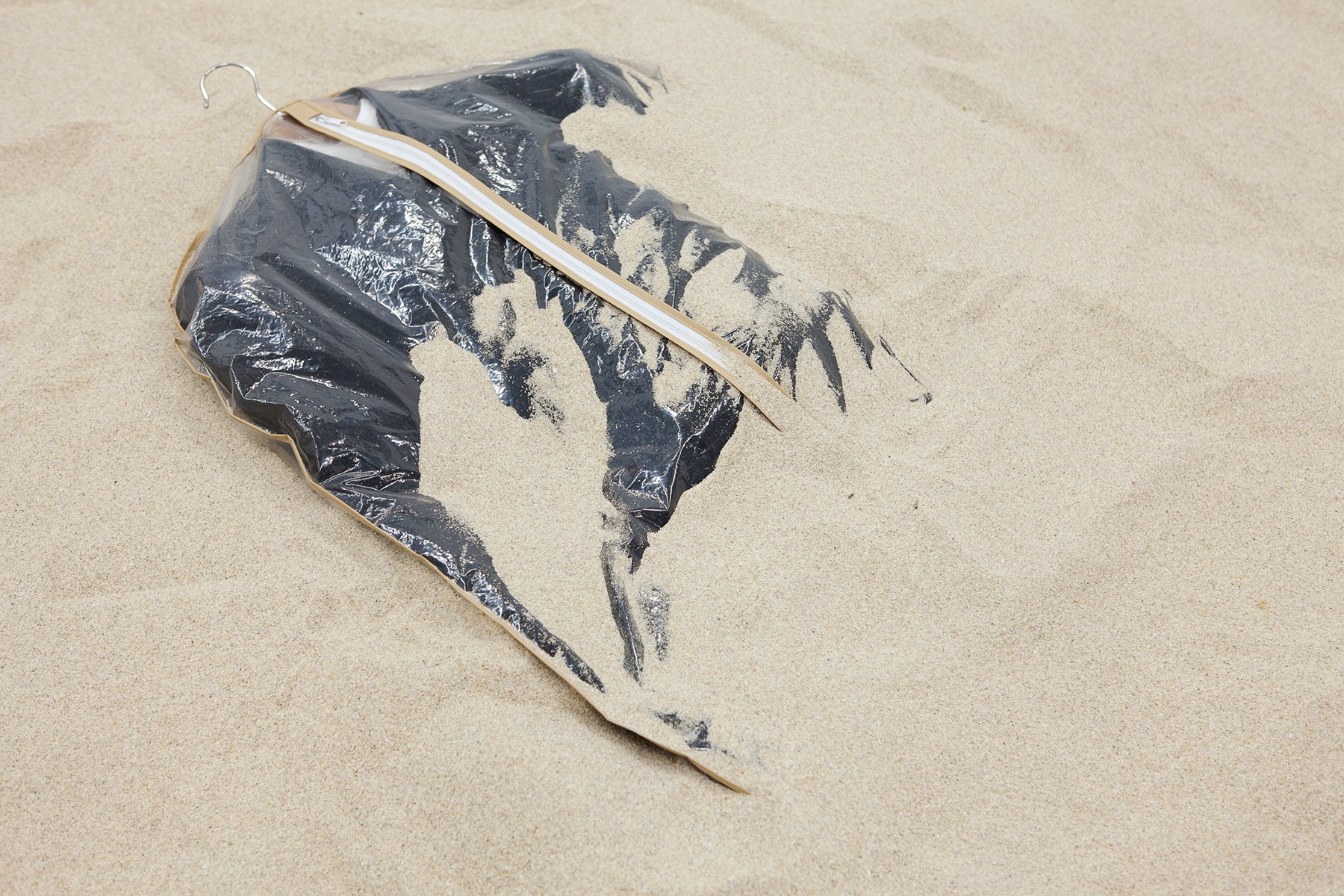
Where does the city without gates begin? Perhaps inside that fugitive anxiety, that shudder that seizes the minds of those who, just returning from a long vacation, contemplate the imminent encounter with mounds of unwanted mail or with a house that’s been broken into and emptied of its contents. It begins with the urge to flee and escape for a second from an oppressive technological environment, to regain one's senses and one's sense of self.1
In you more than you
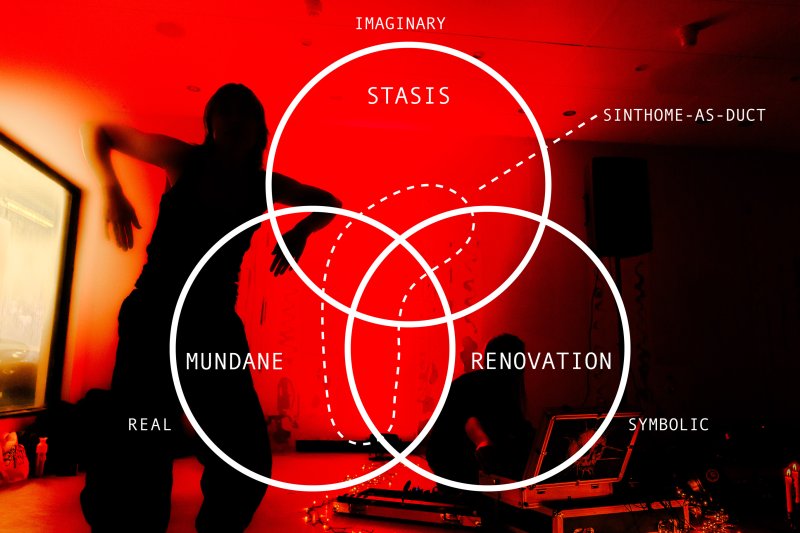
You enter Western Australia, and understand that you’re taken up by an un/so-easy occupancy of an im/so-possible psychosocial structure of permanent renovation. The state is unfinished. Crap is left everywhere. There are holes and gaps and a sense of rapid abandonment. Here, things, ongoing life, are not given. There is a continuity hole, a continuity error.
Yet a you has entered The Western Third, and as a continuous being. The unfinished state is not external to you, nor you it. This is stressful, the continuous discontinuity. It is a state still not detectable in your urine and only gleaned in the trimmings of a performative dwelling we call culture, and more specifically, more finely, it’s ‘art history’.
The fine-meshed gates of art history take you in. A threshold that makes you aware of an unorderable inter-changeable anti-sequence of play-forms: a patchwork of signs and rules adjusting your comportment like flour through a sieve. At the gate, an en-joining dis-claimer: artistic development as land development as vectorised hysterical boom-bust growth cycles as…
The overdeveloped city
Recall that the hysteric inflames power structures to a point where they become visible symptoms, as ducts and conduits, workable only in their unworkability.
Recall how this fashions an in-visible. The west is made up of in-visibilities. Paul Virilio, in his 1984 essay ‘The Overexposed City’, anticipates a State of in-visibility through an analysis of communication, surveillance and shop frontage as a loss of ‘geopolitical reality to the exclusive benefit of systems of instantaneous deportation whose technological intensity ceaselessly upsets all of our social structures’.2
What occurs in this state of invisibility is an ‘overexposed city’ that is seemingly without gates, ‘a world without antipodes and without hidden aspects’.3 The in-tolerable binding of the post-industrial gateless city has a derealisation effect that collapses the development of lived space and public consciousness into itself. A city that is both radically proximate and erasingly liminal. We call this effect gate-craft.
In Perth (itself an acronym beginning with (p)ower and ending in (h)ousing) ‘permanent renovation’ also names this effect. Here, sprawling city developments have modelled culture along the vectors of venturing housing sprawls, destroying Jarrah forests, and astroturfing the land of this extractivist colony. To wit, Virilio helps us see that resultant cultural consciousness struggles to find ‘the essential difference between economic-industrial recession and war’.4
Inasmuch as art history is a gate into cultures present and past, our question is this: what can be written (read and tolerated) about the forces and systems within the overdeveloped city without gates?
Post-retail sprawlogistics: Galleria, 2011-2012.
Perth is a city where mallrat sensibilities are baked deep into its cultural strata. While commodification is a principle of the modern city, in Perth the boom-bust failure of retail appears as a minor thought throughout its histories. As the solitary hub to all the other solitary hubs across the State, Perth’s core function is to organise itself in a similar way that a shopping centre might. In her essay ‘Things to Do with Shopping Centres’, Meaghan Morris writes,
A shopping centre is a ‘place’ combining an extreme project of general ‘planning’ competence (efforts at total unification, total management) with an intense degree of aberrance in diversity in local performance.5
In the city without gates, the ‘gate’ of the shopping centre generates mundanity with precision and control. At the same time, the metabolism of the shopping centre is insatiable: more development, more precinctification, more small businesses, more consignment, more Myer and post-Myer retailism.
The shopping centre, Morris continues,
is also a ‘place’ consecrated to the timelessness and stasis (no clocks, perfect weather…) yet lived and celebrated, lived and loathed, in intimately historic terms: for some, as rupturable event (catastrophic of Edenic) in the social experience of a community, for others, as the enduring scene (as the cinema once was, and the home still may be) of all the changes, fluctuations and repetitions of the passing of everyday life.6
The Imaginary stasis of Perth is a product of its mythopoesis, permeating the everyday. Its ungated nature makes it hard to externalise, except as nodal connective tissues to stretch out and sprawl towards the horizon.
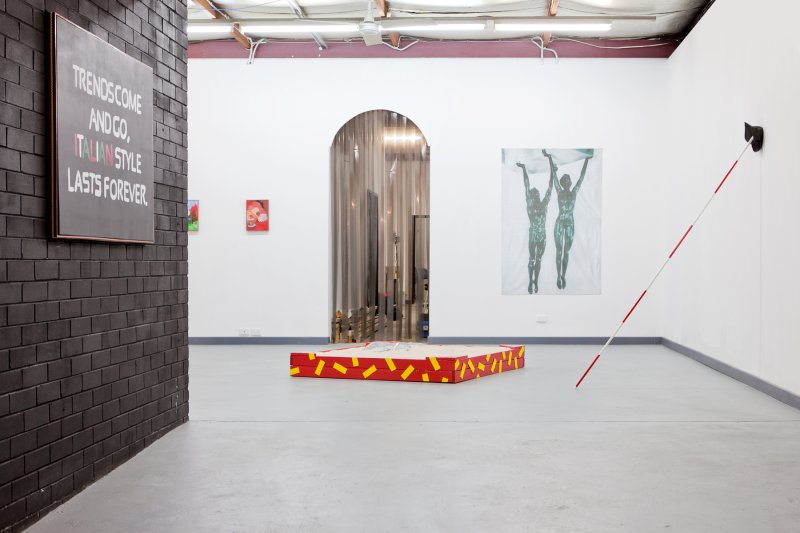
Andrew Purvis, reviewing David Egan and Reece York’s 2011 exhibition at the artist-run gallery Galleria (named after a now soon to be redeveloped shopping centre in Morley) in issue 6.1 of un Magazine, writes,
One can only hope that the long, tedious houses of gallery invigilation are periodically enlivened by Google Maps mix-ups leading bewildered bargain hunters to descend upon the unassuming gallery.7
Purvis is maintaining the typical gates between the so-called ‘art world’ and the rest, not realising that in a city without gates, the thresholds instead are processing vectors for development and consumption.
In Perth, artworlds fail to maintain exclusive gates ‘above’ their subject of study or parody. Instead, they collapse together, which might make Galleria the sincerest exercise in gallery making this country has ever seen.
Melancholy, mundane futurepasts
The longstanding anxiety of Australians confronting the landscape indicates a problem of identity. The void of the land forced to signify, ignoring the suture that it offers. The emergence of the subject, of meaning, occurs through alienation and through a joke. The subject here is divided from its own language and disappears in a pun that is an approximation of the real.8
Here, Juan Davila helps us see the intimate bond between the pressurised spaces of the shop and the voidingness of landscape itself; in these fused reference points sprawl culture is like a low-lying flood plain, a landscape of remorselessly adaptive morphology. A gate-crafted city offers a derealised landscape in excess of the question of landscape itself, akin to ceaselessly replicated junk DNA that freezes time while allowing non-life to keep on moving through it.
Necro sonic
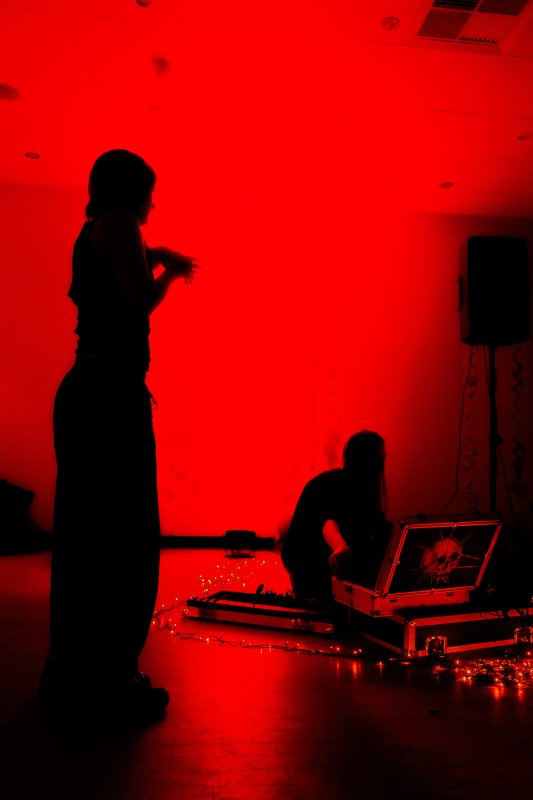
The latent deadpan-deathmask veneer over this culture of impending and continual erosion was enacted in Lara Dorling and Matthew Taggart’s performance at underscore gallery on Saturday 22 November 2025. Matt is sat on the floor, his demeanour flat, playing a range of computer synth elements. His static sound performance made a resistive layer that refused to gel into a melody but was instead an affective extension of something being dragged out of itself such that deadness and liveness could occupy the same space and time.
Ultra face
Lara moved in the way that dancers often move in spaces when people have gathered to watch. At the same time, she was also detachedly meta as if inside an agitated holding mechanism. Through a series of poses her body acted what dancing might be in a zone between the enlivened metabolic and a puppet like unreality. This came to a head in a moment when, as if her strings were cut, she fell and her body and face dropped. And her face became an ultra face: it became a puppet face, a rictus grin that had begun to sink into a whole-body drooping melancholy—‘going through the motions’.
Geopsychoantisociality
The dis-animation of the pair can be taken as an incorporative gesture that helps us envisage an entirely new take on past accretions in the name of an ‘art history’. Its very stillness is a position from which to sense the collapse formations of building and land speculation, and to make evident the manner in which notionally natural elements are part of this geopsychoantisociality.
Prevailing winds
Randolph Stow’s poem ‘The Utopia of Lord Mayor Howard’ published in 1962 begins with the line: ‘The wind has scattered my city to the sheep’. Here, one form of capital is distinguished from another and the city is separated out from the pastoral as if they were different. Our very bracing of this separation is an articulation of the prevalence of the un-gated city state. This is evident almost everywhere you look. See for instance, Vincent Monton’s 1986 film Windrider. In one scene, Stewart P.C. Simpson, played by Tom Burlinson (a Canadian actor acting Australian), is late for his wind surfing heat and runs his little dune buggy (with his sail and board on top) through the fence of a paddock to avoid the sheep slowly being herded down the road. He braces to become Stow’s wind, rendering the sheep of the pastoral realm out of place, as well as ‘in the way’. Of what? Not just his progress, but Progress. One pioneering hero replaces another; Burlinson, after all, enlisted cutting-edge science to assist his efforts on set, echoing Ben Lexcen’s work designing the racing yacht Australia II three years prior.
Economic horizons are in flux. As are, appropriately, horizons themselves. Windrider’s initial conceit occurs when Burlinson has a great morning session, climaxing with an aerial 360. The nocturnal singer Jade, played by Nicole Kidman, having just finished a night recording session is the only witness to P.C. Simpson. Nothing unusual there. The figure of the wind brings P.C. Simpson and Jade together. Yet to fashion the wind’s morning rush, a dramatic alteration had to occur. In their morning near-meet-cute, the sun is on the horizon. This makes sense if it this was an east coast film, and why should we assume it isn’t? Yet it becomes clear, as the particulars of the landscape come into view, that it is a west coast film. It then becomes clear that the director had to do some dis/continuity work to get the sea breeze, which typically arrives from the south-west in the afternoon to buffet the water enough for wind surfing to occur, and for the meeting of different chronotypes.
Vector of implication
Following the logic of all colonial art, Windrider ensures that romantic plausibility trumps geographical plausibility. Such displacements and forced out-of-placed-nesses are amplified throughout the movie. Throughout these turns the wind is not overcome, but locked into, ridden.
We should be clear: this is not a new moving-into-step with place but a statement of the potential for its employment as a figure to unsettle the settling while not resolving it; to dislodge, to insist on the in between transitory states that are tensioned, put under constant stress. The stress of a colony. It is the deathmask State in propulsive meaningless motion, as an accreted symptom of the erosive cascade into the forlorn. This state of being creates a subject formation and cultural formations that exist as ‘a vector of implication’.9
Giving duct
We wonder whether we might begin to write histories not as antidotes, but as discrete orienting statements about this cultural condition. And in the spirit of environmental conditioning, it occurs to us that the figure of the air conditioning duct can help us understand the compressions and collapses, the leakages and seepages, and the strange linkages that disperse and derealise time and place. After all, the duct is functionally individualised; it draws from the energy of the platform, the grid, while having localised effects and being in essence a hollow shape that only winds can take other journeys through. The duct is neither an outside nor an inside, and in this state, it is the form of a strangely focused neutrality that envelopes you as it performs the collapsing of its perimeters: east coast west, capital and country, agent and object, musician and dancer, gallerist and artist, artwork and critic.
The ducts between so-called gates are conduits of collapsibility. The function of collapse enacts a continuity error which amplifies the hystericism of gate-craft’s missionary appeal to rational art history vis-à-vis an evidential paradigm.
What actually happens here?
Duct as Windsock Sheath
It is equally from the generative vantage point of our unfinished renovation of Western Australian exceptionalism, that we can now glimpse our ducted air conditioning dejectedly casting a line towards a global circulatory compression of time and place for which ambient culture finally becomes its truly ambivalent self… Culture as ‘a way of life’ in the sense that Raymond Williams’ meant, comes to be known in a specific yet impossible future moments when we empty the system’s filters and, when, no doubt, the intensifications of the Freudian membrane resituated in cleansing fine mesh grids create an unexpected pressure so oddly pleasurable in its distinctively non-circulatory tone that we may well find ourselves once again impelled to turn in fear of ecstatic overwhelm and to sift the leavings as re-ducting hermeneuticists.10 It occurs to us that this yet-and-never-to-come-moment of breakage has, however, been the utterly fantastic and phantasmic position we have always been writing and thinking from, as we take on the responsibility of acting as decoy gates, as filters, as windsocks while the system flows through and around us, blissfully and ambiently untouched.11
1. Paul Virilio, Lost Dimension, translated by Daniel Moshenberg, Semiotext(e), New York, 1991, p.33.
2. Virilio, p.33.
3. Virilio, p.37.
4. Virilio, p.39.
5. Meaghan Morris, ‘Things to Do with Shopping Centres’, Gender Space Architecture, Routledge, 2000, p.177.
6. Morris, p.178.
7. Andrew Purvis, ‘David Egan & Reece York’s Seria Ludo’, un Magazine 6.1, 2012, https://unprojects.org.au/article/david-egan-reece-yorks-seria-ludo/, accessed 10 September 2026.
8. Juan Davila, ‘Landscape Art in Western Australia’, Praxis M 2, 1983, p.25.
9. Ben Lerner, Hatred of Poetry, 2016, Fitzcarraldo Editions p.71 (Kindle Edition)
10. See, for instance, Raymond Williams, The Country and the City, 1993, The Hogarth Press; London
11. Jean-Paul Sartre, The Imagination, 2012, Routledge, London, p.33-34. A beautiful illustration of this naïve thingism (chosisme) of images is provided by the Epicurean theory of ‘simulacra’. Things keep emitting ‘simulacra’, ‘idols’, which are just sheaths. These sheaths have all the qualities of the object—content, shape, etc. And it is exactly the case that they are objects. Once emitted, they exist in themselves, just like the emitting object, and can wander in the air for some undetermined time. Perception will occur when a sensory apparatus encounters and absorbs one of these sheaths.
Author/s: Robert Cook & Paul Boye
Robert Cook & Paul Boye. 2026. “Permanent Renovation: Westerngatedreverbre-leaseestatecoastaltrimmings.” Art and Australia 61, no.2 https://artandaustralia.com/61_2/p489/permanent-renovation-westerngatedreverbre-leaseestatecoastaltrimmings
Art + Australia Art + Australia ISSN 1837-2422 All content published after October 2023 by Art + Australia is available under a Attribution-NonCommercial-NoDerivs 4.0 International Licence (CC BY-NC-ND 4.0) except where otherwise stated. For more information about use and distribution you can view our Editorial Guidelines. Art + Australia is a University of Melbourne research project
Publisher: Victorian College of the Arts
University of Melbourne


